Skip to content
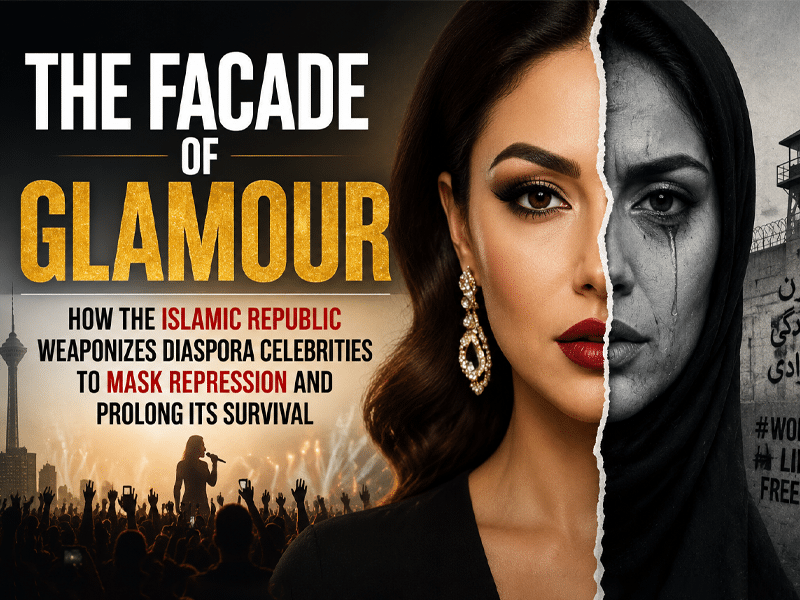
The Facade of Glamour: How the Islamic Republic Weaponizes Diaspora Celebrities to Mask Repression and Prolong Its Survival
Throughout history, authoritarian regimes facing crisis or decline have consistently turned to art, music, celebrities, and curated symbols of “normal life” to mask brutality and project an image of vitality. From Hitler’s grandiose rallies and Franco’s folkloric tourism campaigns to Ceaușescu’s orchestrated festivals—and in contemporary times, the spectacle-driven propaganda of North Korea, Russia, and China—dictators have relied on cultural manipulation to distract from repression and violence.
The Islamic Republic of Iran has elevated this tactic to a new level of sophistication in the 21st century. As the regime intensifies its crackdown on dissent—especially following the widespread uprisings of 2025 and 2026, marked by mass arrests, torture, and executions—it has simultaneously launched a calculated campaign to import or rehabilitate glamorous figures from the Iranian diaspora. These include singers with Hollywood polish, models celebrated for their bold or unveiled imagery, and social media influencers who embody the very Western lifestyles the regime publicly denounces.
This is not a spontaneous or organic cultural exchange. Dissidents both inside and outside Iran describe it as a deliberate, long-term strategy orchestrated by the regime’s security apparatus, particularly the Islamic Revolutionary Guard Corps (IRGC). The objective is multifaceted: to manufacture an illusion of normalcy and national reconciliation, to project an image of cultural openness, and to demoralize the opposition. By showcasing these figures, the regime seeks to reassure loyalists, attract foreign investment and tourism, and blunt international condemnation of its human rights abuses.
While families grieve for executed protesters, morality police enforce strict hijab laws, and prisons overflow with political detainees, state-controlled media broadcasts images of returning celebrities reciting Quranic verses, performing at religious festivals, or posing in carefully staged “everyday” scenes. These spectacles are designed to overwrite the reality of repression with a narrative of unity and progress, even as the machinery of state violence grinds on in the background.
Gheysar (Binesh Bolour): In early June 2026, Gheysar, the Los Angeles-based Iranian pop sensation renowned for his energetic, dance-driven hits and a career that has spanned generations across the Iranian diaspora, made a dramatic return to the Iranian stage. For the first time in decades, he performed publicly in Tehran, headlining a major state-sponsored Eid al-Ghadir celebration held in the iconic Imam Hossein Square. The event, orchestrated with significant fanfare and broadcast widely by state media, saw Gheysar deliver his signature song “Tehran” to a massive crowd, many of whom responded with patriotic chants and visible enthusiasm.
Gheysar’s return was especially notable given his long-standing ban from performing in Iran—a prohibition partly rooted in his previous concerts in Israel and his association with the Westernized Iranian music scene. The regime’s media framed his appearance as a momentous homecoming, emphasizing themes of reconciliation and national pride. Supporters hailed the event as a symbol of cultural unity, celebrating the return of a beloved artist to his homeland after years of exile.
However, the performance also drew criticism from various quarters. Detractors argued that the event represented a calculated effort by the authorities to blend the mass appeal of pop culture with the religious significance of Shia festivities, particularly to engage younger Iranians who might otherwise feel alienated from official celebrations. By showcasing a figure like Gheysar—whose music and persona have often been seen as emblematic of the Iranian diaspora’s Western influences—the regime appeared to signal that even artists with “Westernized” backgrounds could find acceptance and success within the framework of the Islamic Republic, provided they align themselves with state-sanctioned narratives and events.
The spectacle thus became a focal point for debates about cultural policy, generational change, and the evolving relationship between the Iranian state and its global diaspora. For many, Gheysar’s performance was more than just a concert; it was a carefully staged moment of political theater, blending nostalgia, nationalism, and religious pageantry in a bid to reshape the boundaries of cultural legitimacy in contemporary Iran.
Moein (Nasrollah Moein), the cherished balladeer whose soulful voice defined the pre-revolutionary era and later became a pillar of the Tehran gelées music scene, has long been a figure of fascination for the Iranian government. In recent years, officials from both the Foreign Ministry and the Ministry of Culture have made several public gestures, signaling a willingness to welcome Moein back to Iran. These overtures have included hints of “promising news,” as well as the possibility of granting him special permissions to perform—though often with significant conditions attached.
Despite these repeated invitations, Moein himself has reportedly remained cautious and unconvinced, wary of the regime’s intentions and the potential risks involved in returning. Nevertheless, the government’s persistent courtship of Moein highlights a broader strategy: by reaching out to iconic artists whose music evokes deep nostalgia and emotional resonance, the regime hopes to rehabilitate its image, particularly among moderate Iranians and older generations who grew up with Moein’s songs. This effort to leverage the power of Persian ballads and cultural memory reflects an ongoing attempt to bridge generational divides and soften public perceptions, even as skepticism lingers among the very artists they seek to embrace.
There is widespread speculation that the ongoing cat-and-mouse dynamic between Moein and the Islamic Republic of Iran is nothing more than a carefully orchestrated performance. Many believe that Moein has remained a covert agent for the regime within the Iranian diaspora, strategically positioned to serve the government’s future propaganda efforts and long-term plans. According to these theories, his public opposition may be a façade designed to build credibility and influence among Iranians abroad, only to be leveraged by the regime when the time is right. This perspective suggests that Moein’s actions and statements should be viewed with skepticism, as they may ultimately align with the interests of the Islamic Republic rather than those of the opposition.
Sadaf Taherian, an actress and model who first gained widespread attention in 2015 for boldly sharing unveiled photos in open defiance of Iran’s compulsory hijab laws, became a symbol of resistance against state-imposed dress codes. Her actions triggered a fierce backlash from authorities, resulting in the revocation of her professional license and ultimately forcing her into exile. Over the years, Taherian cultivated a massive social media following, amassing millions of fans drawn to her outspoken advocacy and glamorous, boundary-pushing image in the diaspora.
In a surprising turn of events in 2026, reports emerged that Taherian had deleted her extensive social media accounts and quietly returned to Iran. This move has sparked intense debate and speculation. Dissident commentators suggest that her return may be linked to pressure or influence from the Islamic Revolutionary Guard Corps (IRGC), arguing that her once rebellious and independent persona is now being co-opted for state propaganda purposes. They point to a broader pattern in which the regime seeks to reclaim and repurpose the images of high-profile exiles to project an image of reconciliation and strength.
Meanwhile, regime-aligned media and officials have framed Taherian’s return as a gesture of forgiveness and national unity, holding her up as an example of the state’s willingness to welcome back those who once opposed it. Critics, however, view these orchestrated returns with skepticism, describing them as opportunistic attempts at image rehabilitation—both for the individuals involved and for the regime itself. The controversy surrounding Taherian’s return highlights the ongoing struggle over personal freedom, state control, and the power of public image in contemporary Iran.
Pooyan Mokhtari and the Optics of Religion: Pooyan Mokhtari, a prominent influencer, singer, and model, is widely recognized for his ostentatious lifestyle, frequent associations with gambling, and outspoken support for the Iranian regime. Despite his reputation for pushing social boundaries, Mokhtari has been strategically featured in religious settings—most notably through Quran recitations that are either commissioned or heavily promoted by media outlets linked to the Islamic Revolutionary Guard Corps (IRGC). This deliberate blending of a provocative, celebrity persona with overt displays of Islamic devotion serves a calculated purpose: to soften the image of hardline ideology, making it more relatable and appealing to secular-minded youth and segments of the population who may feel alienated or disillusioned by the regime’s traditional messaging.
Such cases are emblematic of a broader, systematic effort by the Iranian authorities to co-opt influencers and members of the diaspora. The regime reportedly allocates substantial financial resources—often amounting to millions of dollars—through organizations like the Islamic Culture and Relations Organization. These funds are used to sponsor influencer trips, secure promotional contracts, and generate curated content that presents a sanitized, attractive version of life in Iran. This content typically highlights modern cafes, fashion trends, and tourist destinations, while deliberately omitting or downplaying the realities of political repression, including executions and mass arrests. The overarching goal is to reshape both domestic and international perceptions, using the allure of celebrity and lifestyle to distract from and obscure the regime’s ongoing human rights abuses.
Dissidents contend that these high-profile returns are rarely spontaneous; rather, they are often the result of years-long cultivation by the authorities. Tactics include generous financial incentives, leveraging family ties and obligations, promises of reviving stalled careers, or more insidious forms of pressure and subtle coercion. When these figures return, their previous acts of defiance are systematically erased or downplayed, and their reappearance is carefully staged to produce striking images: a former anti-hijab activist now pictured back “home,” a once-banned pop star performing at a state-sponsored Shia festival, or a notorious gambler publicly reciting the Quran.
Such orchestrated spectacles are designed to sow cognitive dissonance—sending the message, “Even they have chosen the Islamic Republic”—and to fracture solidarity within the diaspora. The regime uses these returns to project an image of resilience and legitimacy, even as it faces economic collapse, widespread protests, and deepening international isolation.
It is important to acknowledge that not every return is purely the result of manipulation; some individuals may be motivated by genuine homesickness, family needs, or pragmatic considerations. Yet, the conspicuous timing of these returns—often coinciding with periods of heightened unrest or immediately following waves of repression—along with their seamless coordination with state propaganda, exposes the underlying cynicism of the strategy.
Dissenting celebrities who refuse to comply face harsh consequences: bans from working, forced exile, or even graver threats. In contrast, those who cooperate are rewarded with renewed visibility and official platforms. The regime further amplifies these narratives through state-controlled media and sophisticated use of social media algorithms, ensuring that the spectacle reaches audiences both inside Iran and across the global Iranian community.
This carefully constructed cultural facade comes at a devastating human cost. While celebrities like Gheysar perform on stage and figures such as Taherian make public returns, the families of those killed during the January 2025 and December 2026 uprisings are left to mourn in silence, their grief deliberately erased from public consciousness. Meanwhile, political prisoners—including women who bravely defy compulsory hijab laws and protesters demanding basic rights—endure torture, unjust imprisonment, and even execution. The regime’s relentless promotion of “normalcy” is not merely a distraction; it systematically numbs public empathy, weakens collective resistance, and grants the authorities precious time to consolidate their power.
This narrative of normalcy also distorts the very essence of Iranian identity, reducing the nation’s rich and diverse Persian heritage to a series of regime-sanctioned spectacles. Genuine cultural expression is stifled, replaced by orchestrated performances that serve only to legitimize the status quo. For those who envision a free, democratic, and secular Iran, exposing this dual reality is not just important—it is imperative. Shedding light on these contrasts humanizes the victims, counters the regime’s pervasive disinformation, and galvanizes international and domestic support for meaningful change.
As outlined in proposals for national memorials and remembrance initiatives (alirahimibooks.com), honoring the memory of all who have resisted—across generations and backgrounds—is essential. Such remembrance must reject the regime’s selective forgiveness and staged reconciliation, instead embracing a truthful and inclusive narrative that acknowledges the full spectrum of sacrifice and resistance.
True Iranian culture can only flourish in an environment of freedom, not under the shadow of coercion and fear. Diaspora artists, intellectuals, and the Iranian people themselves deserve platforms that are free from the influence and manipulation of the IRGC and other regime apparatuses. By documenting and amplifying the stark contrasts between state-sponsored glamour and the private anguish of countless families, we preserve historical truth, support the courageous individuals still fighting inside Iran, and move closer to realizing a vision of a reborn nation—one founded on justice, pluralism, and the inherent dignity of every human being.