The Other Hand of Life
How molecules choose a hand, why living chemistry keeps only one, and what scientists mean by mirror life.
Illustrated essay for a general reader. The cartoons are metaphors, not laboratory diagrams. Green stands for the hand life uses. Blue stands for the reflection. About 1,200 words.
In 1848 a young chemist in Paris sat over a tray of crystals and sorted them with tweezers. Louis Pasteur had been told that two acids from wine were the same in every way that mattered, except that one twisted a beam of light and the other did not. Looking closely, he saw that the inactive crystals came in two shapes. Each had a small extra face. On some crystals the face leaned one way, on others the opposite way. They were related as a thing is related to its image in a mirror. Dissolved separately, one pile twisted light to the right and the other to the left. Mixed again, they cancelled. The inactive acid was not a third substance. It was a pair.

Figure 1. Pasteur sorting mirror-image crystals. The two shapes cannot be laid on each other.
That afternoon is the start of the idea now called mirror life. Pasteur had found that molecules can be left-handed or right-handed, and that living things can tell the difference. A mold he later studied ate one form of tartaric acid and left the other in the jar. Ordinary chemistry often treats the two as twins. Life does not. In lectures in 1860 he went further. The products of life, he said, are dissymmetric, his word for a shape that cannot be laid on its mirror image. Laboratory syntheses of the same compounds, when they worked, gave both hands at once. Life gave one. He guessed that the cause was cosmic. He could not show it. The fact he left behind is still the fact: every organism examined since is chemically one-sided.
One hand, kept
The modern name for that one-sidedness is homochirality. A chiral molecule is not superposable on its reflection, just as a left glove is not a right glove. The two forms have the same atoms and the same bonds. They differ only in the order of groups around certain carbons. Water has no such twin. Phosphate has none. Glycine, the smallest amino acid, has none, because two of its attachments are identical. Most of the rest of the kit does.
Proteins are chains of amino acids, and nineteen of the twenty common ones have a hand. The cell’s protein-making machine, the ribosome, installs only the left-handed form, called L. The chain then folds. A helix is a repeating set of angles and hydrogen bonds, possible because every link has the same configuration. A sheet is the same fact in a flatter shape. A right-handed amino acid in that chain points the wrong way. A few can be placed on purpose, as bacteria do in their cell walls, by special enzymes after the chain is built. A random mixture cannot fold the same way twice. The spring loses its register.
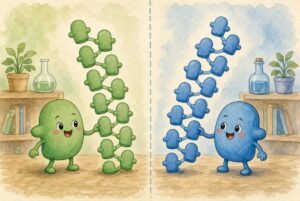
Figure 2. A protein keeps one hand. The reflection is a coherent chain only if every link is reversed together.
Nucleic acids carry the other commitment. In a nucleotide the base is flat and the phosphate is not chiral. The hand sits in the sugar. RNA uses a right-handed sugar, D-ribose. DNA uses the same configuration with one oxygen removed. That sugar holds the bases at a fixed angle, and the chain of them spirals as a right-handed helix under ordinary conditions. A chain of the mirror sugar would spiral the other way. The letters of the code would still match in the abstract, adenine with thymine, guanine with cytosine, but the backbone has to present them at the right distance. Worse, copying stalls. Experiments on RNA chains have shown that a nucleotide of the wrong hand, added to a growing strand, effectively stops the next link. A soup of both sugars does not yield long genes. It yields short pieces that jam.
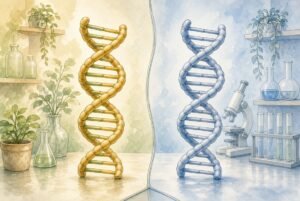
Figure 3. DNA and its mirror. The letters can still pair. The backbone that holds them cannot mix the two hands.
Why a mixture fails
This is why a symmetric mixture is not a biochemistry, and why the phrase has to be handled with care. Symmetry itself is not the enemy. Life uses achiral parts freely. A fully reversed system would also be coherent inside its own membrane. Its enzymes would fit its substrates. Its genes would copy. Evolution would not care which hand had been chosen, only that the choice was consistent. What fails is the mixture, and what fails at the border is recognition.
An enzyme is a shaped pocket. The substrate has to present the right groups to the catalytic parts. The matching hand binds and reacts. The mirror hand misses the pose, or does not bind at all. Pasteur’s mold was an early, clumsy version of that lock. A polymerase evolved for one sugar rejects the other. A ribosome evolved for left-handed amino acids rejects the right-handed ones. Once a cell has committed, the other hand is not a variant of the same food. It is a shape the machinery was not built to hold.
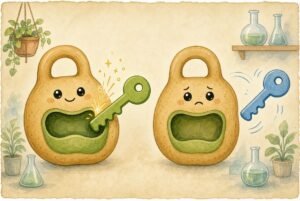
Figure 4. An enzyme fits one shape. The mirror key does not turn the lock.
A second tree, and a line
Mirror life is the thought experiment of completing the unused hand into a cell. Every chiral part would be reflected: right-handed amino acids, left-handed sugars, mirrored surface sugars and lipids. Water, phosphate, and glycine would be shared, because they have no mirror form. Inside the cell, nothing would feel backwards. Proteins would fold. A helix would spiral the other way. Metabolism would run on mirrored substrates. The foreignness would appear only at the door. Immune receptors, phage tails, predatory microbes, and digestive enzymes are locks cut for one hand. A mirror cell would present the other.
That blindness is the scientific interest, and it is the reason a group of researchers changed their minds. For years the project looked like a distant curiosity, then like a factory. Mirror peptides survive the enzymes that cut ordinary proteins, so they are attractive as longer-lasting drugs. Mirror nucleic acids resist the enzymes that cut ordinary genes, so they are attractive as diagnostics. In 2016 a laboratory built a mirror enzyme that copies DNA. In 2022 another built a mirror enzyme that makes RNA, and used it to transcribe long pieces of a ribosome. A working mirror ribosome, the machine that would make mirror proteins from a gene, has not been assembled. Nor has a mirror cell. Estimates still put a first mirror bacterium a decade or more away, and not within the reach of a single ordinary lab.
In December 2024, thirty-eight scientists, some of whom had wanted to build the cell, published a warning in Science, with a long technical report beside it. Their argument has three parts, all theoretical, because the organism does not exist to test. Many immune defenses recognize chiral patterns on a bacterial surface, so a mirror surface might be cleared less easily in people, animals, and plants. Many viruses of bacteria, and many predators, are also chiral, so a mirror population might not be held down as ordinary bacteria are. And if the cell can live on achiral nutrients, a release is not a spill that dilutes. It is the start of a lineage. They did not claim that every defense would fail, or that the cell would be easy to make. They claimed that the downside of being wrong is large, and that curiosity is not a sufficient reason. Several of them stopped the work.
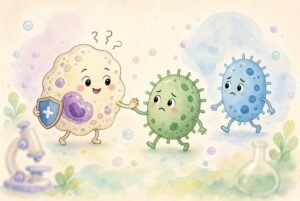
Figure 5. Immunity is built to recognize a familiar surface. A mirror germ does not present that surface.
The line they drew is the useful one for a general reader. A mirror molecule is a tool. A sealed flask of mirror chemistry can be a medicine. A mirror organism would be a second tree, sharing our water and blind to our locks. Building the first is not required for the drugs. The hard remaining machine, a mirror ribosome, is where a factory and a lineage become difficult to tell apart, which is why the argument is now about governance as much as about chemistry. Funders, journals, and governments have been asked to keep that distinction sharp before the pieces, developed for other reasons, can be combined.
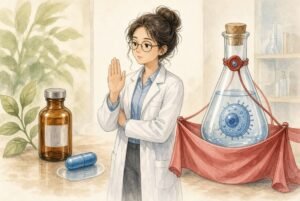
Figure 6. The line drawn in 2024: mirror molecules may be medicine. A mirror cell is the step the authors say should not be taken.
Nothing in this requires panic, and nothing in it is science fiction of the loose kind. No mirror animal has been made. No mirror germ is loose. The other hand of the molecule is already real, in crystals, in drug candidates, in enzymes that copy only their own reflection. The open question Pasteur could not close is still open: why life was offered one hand, or why it kept only one. Mirror life is the proposal to answer by building the other. The quieter conclusion, from the people nearest the tools, is that the reflection is worth studying as chemistry, and not worth completing as a creature.
A note on the pictures
The six cartoons were drawn to accompany this essay. They compress the argument into a sequence: Pasteur’s crystals, a protein and its reflection, DNA and its mirror, an enzyme that rejects the wrong key, an immune cell that does not recognize a mirror germ, and the distinction between a medicine and a living cell. A short captioned animation of the same frames is saved separately as a video and a GIF. The pictures are teaching metaphors. They are not structural models, and the blue cell in the last frame is a diagram of a boundary, not a depiction of an existing organism.
Principal sources for the scientific claims: Pasteur’s 1848 resolution of sodium ammonium paratartrate and his 1860 lectures on molecular dissymmetry; the Joyce group’s finding that a wrong-handed nucleotide stalls RNA copying (1984); mirror DNA polymerase (2016) and mirror T7 RNA polymerase used to make ribosomal RNA (2022); Adamala and colleagues, technical report on mirror bacteria, and the accompanying warning in Science, 12 December 2024.