Skip to content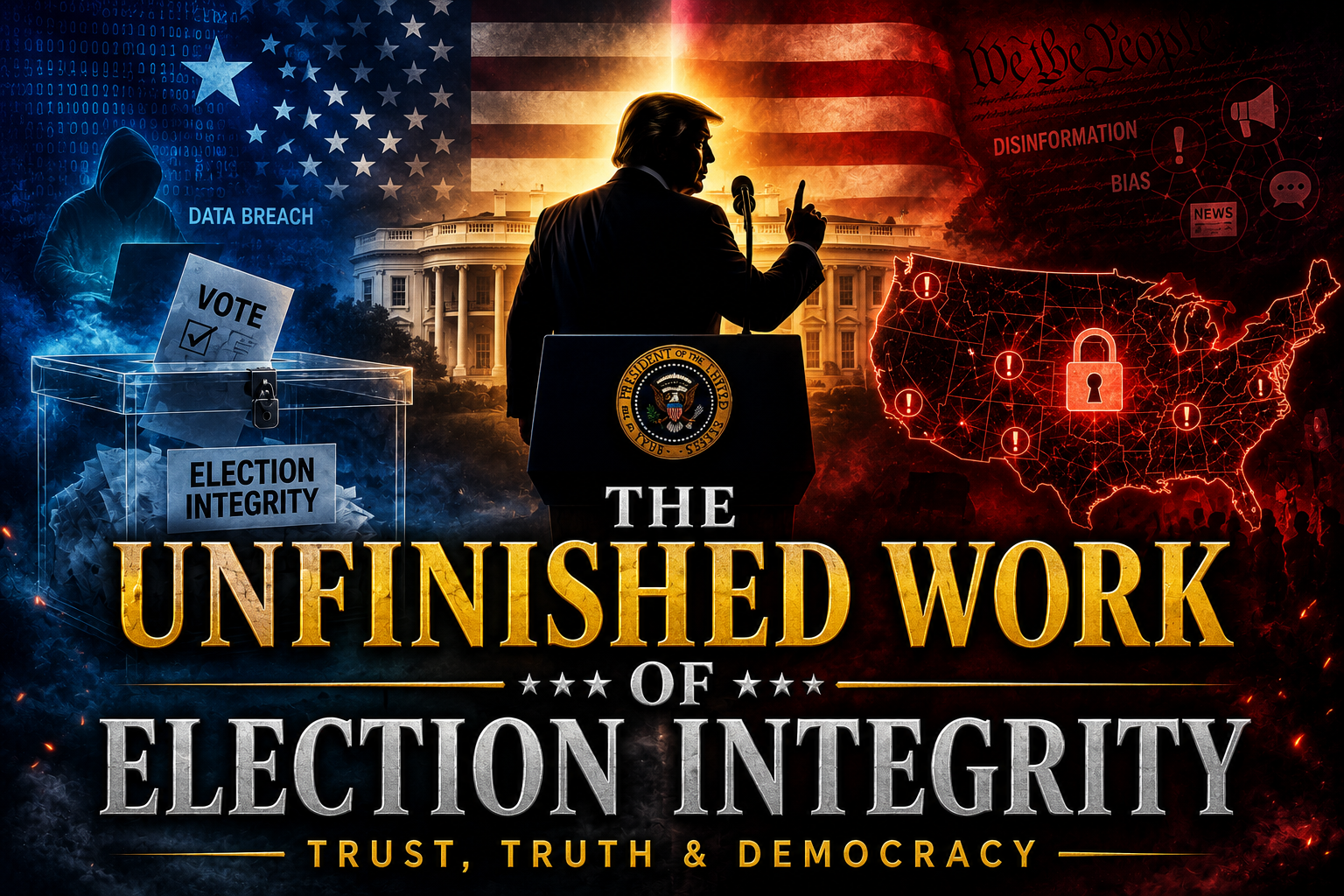
The Primetime Address, the Partisan Mirror, and the Unfinished Work of Election Integrity

On the evening of July 16, 2026, President Donald Trump delivered a primetime address from the White House focused on the security and legitimacy of the American election process. He announced the declassification and release of intelligence documents that, according to the administration, revealed significant vulnerabilities: the largest known compromise of U.S. voter data by China (involving roughly 220 million voter files containing names, addresses, party preferences, and other details), alleged suppression of related information by elements within the intelligence community, findings of non-citizens on voter rolls, and concerns about electronic voting systems. The president framed these as evidence that the current system falls “catastrophically short” of the standard required for free and fair elections and used the moment to press for passage of the SAVE America Act—legislation emphasizing voter identification, proof of citizenship, and tighter rules on mail-in ballots.
Within hours, the coverage sorted itself into the familiar partisan grooves. Outlets and commentators aligned with one side treated the documents as vindication of long-standing warnings. Outlets and commentators aligned with the other side treated the address as a rehash of debunked 2020 claims, noting that the materials did not demonstrate that any votes had been manipulated or that any election outcome had been altered. The Associated Press reported that the allegations “failed to produce evidence that votes had been manipulated” and highlighted the decentralized character of American elections—more than 10,000 jurisdictions with varying rules—as a source of resilience rather than weakness. Reuters and others noted the president’s criticism of networks that declined to carry the speech live and his suggestion that license revocation could be an appropriate response for those he accused of protecting fraud.
An independent citizen who has voted in every election since 1996, choosing candidates according to agenda, record, and competence rather than party loyalty, finds the predictable binary exhausting and corrosive. The pattern is not new. Accusations of irregularities—double voting, ballots cast in the names of the deceased, localized fraud, or procedural failures—have surfaced after multiple elections across decades. Investigations, audits, and court reviews have repeatedly concluded that while isolated problems occur, they have not been shown to reach a scale that changes statewide or national outcomes. That conclusion is not the same as a claim of perfection. No large-scale human system is free of error or occasional corruption. The relevant questions remain: Where do documented problems concentrate? Are there repeating patterns by jurisdiction, method, or demographic? What institutional incentives allow them to persist? And what combination of technology, law, and culture would reduce them without creating new barriers or new avenues for abuse?
Decentralization itself is both strength and vulnerability. Running elections through thousands of local jurisdictions makes coordinated national-scale manipulation extraordinarily difficult. It also produces uneven standards, uneven training, uneven equipment, and uneven transparency. Larger, more urban, or more demographically fluid states face different administrative burdens than smaller or more stable ones. “Sanctuary” policies and rapid population changes in certain states introduce additional complexity around voter-roll maintenance. These are practical problems, not abstract theory. Millions of undocumented immigrants live in the United States; millions more are naturalized citizens who arrived from systems in which elections were neither free nor fair. Civic literacy is not automatic. A healthy democracy requires more than legal eligibility; it requires a shared understanding of the reciprocal duties of citizenship. That observation is not an indictment of any ethnic or national group; it is a statement about the difficulty of transmitting political culture across discontinuous experiences of government.
The same independent perspective applies to the media controversy surrounding the address. Private networks are entitled to decide what they broadcast. Declining to give live primetime carriage to a presidential speech is an editorial choice, and editorial choices can be criticized as biased or shortsighted without violating the First Amendment. At the same time, a president using the authority of his office to threaten the licenses of networks that refuse to air his remarks raises its own set of concerns about viewpoint discrimination and the proper limits of regulatory power over the public airwaves. Both the refusal and the threat feed the same public cynicism: that institutions are primarily interested in protecting their own narratives rather than informing the citizenry and letting citizens judge.
America has spent enormous sums on special counsels and investigations whose primary product often appears to be partisan theater. A more constructive alternative would be a genuinely bipartisan, time-limited commission charged with examining the practical architecture of election administration. Its mandate should be narrow and evidence-driven: map documented vulnerabilities and irregularities by jurisdiction and method; evaluate the trade-offs of greater uniformity in voter identification, citizenship verification, and chain-of-custody rules for ballots; assess the cybersecurity and auditability of voting equipment; and recommend clear, enforceable penalties for proven interference or fraud—penalties applied through ordinary courts, not political tribunals. The goal is not “centralization” in any authoritarian sense, but coherent national minimum standards that still leave operational control with the states. Public confidence is not a partisan commodity. When large numbers of citizens on either side believe the process is systematically tilted, the legitimacy of outcomes erodes regardless of which party benefits in a given cycle.
The deeper problem is cultural. A democracy that treats every contested election as existential warfare, every procedural improvement as either voter suppression or voter fraud, and every media choice as either courage or collusion will continue to generate the very radical alternatives—third parties of the extreme left or right, or fantasies of dismantling constitutional structures—that thoughtful citizens rightly fear. Capitalism, like elections, is imperfect and self-correcting only when the rules are transparent and the referees are trusted. The same principle applies to the franchise.
Citizens who refuse to outsource their judgment to partisan media or partisan politicians still have the capacity, and the duty, to examine primary evidence, demand transparent data, and insist on systems that are both accessible and accountable. The July 16 address and the reaction to it illustrate how far we remain from that standard. The documents should be scrutinized independently. The historical record of investigations should be acknowledged honestly. And the practical work of strengthening election administration—uniform rules where they reduce real risks, rigorous enforcement against proven abuse, and civic education that treats citizenship as a serious responsibility—should proceed without the distorting lens of team loyalty. That is the work independent voters have always claimed to want. It remains unfinished.