The Big Tent
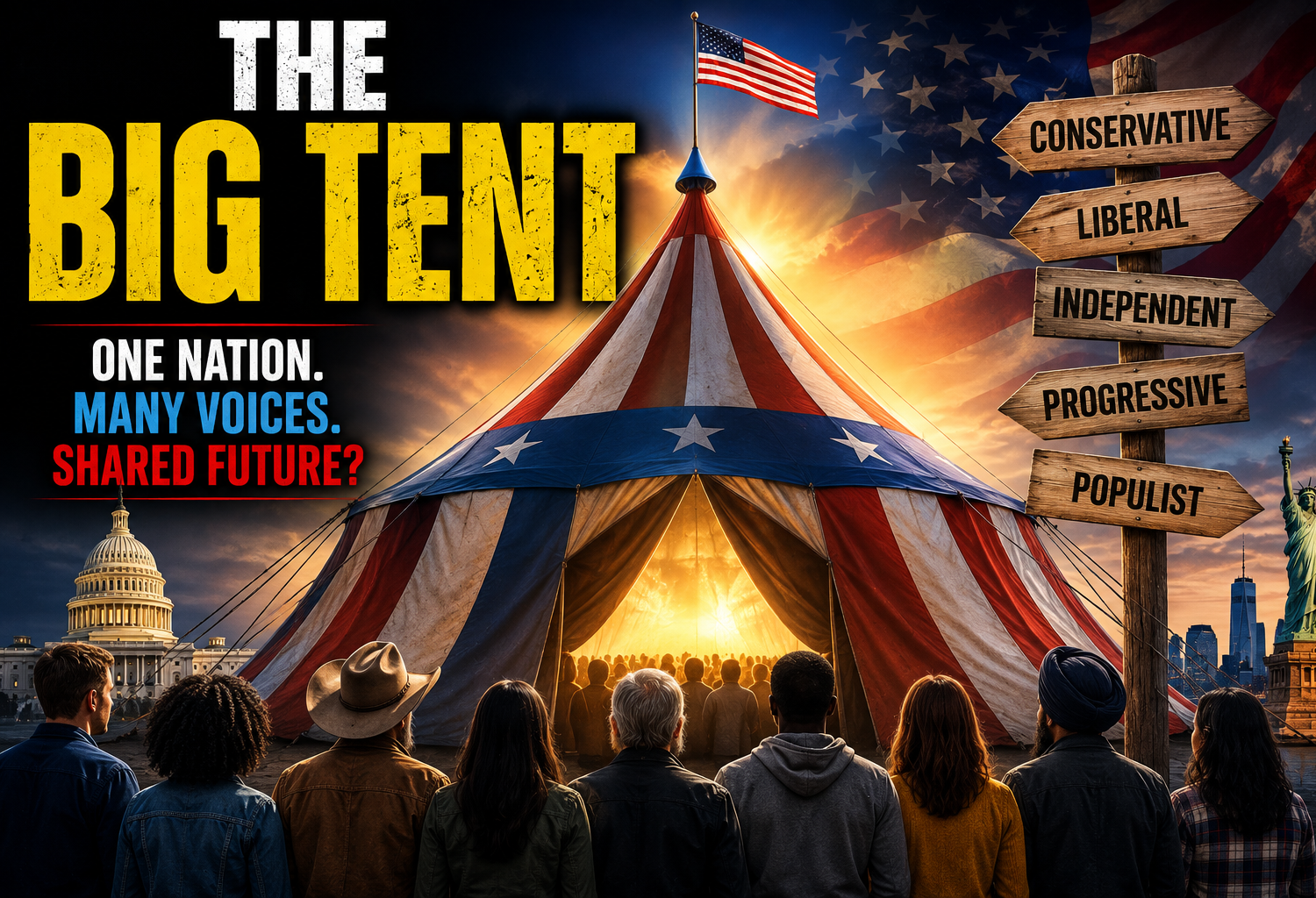
From time to time, politicians seize upon a talking point or buzzword designed to resonate with a broad swath of the public, often targeting both the higher and lower echelons of society. They carefully select language that appeals to many, but in distinct ways depending on the audience. Recently, President Biden, Senator Chuck Schumer, Congresswoman Alexandria Ocasio-Cortez, and numerous Democrats have invoked the idea of the “big tent” and unity. The “big tent” is a classic coalition metaphor, intentionally sacrificing structural rigidity for a wider appeal. Politicians favor it because it signals inclusion but does so in different registers: to institutional players, it promises pragmatic majority-building and electoral advantage; to activists and identity-focused groups, it offers recognition, moral priority, and policy leverage.
This duality allows the same phrase to function as both a centrist managerial slogan and a progressive rallying cry—at least until the practical demands of governance force difficult trade-offs. In American politics, the “big tent” is not exclusive to Democrats or to Biden. Both major parties have invoked it at pivotal moments to absorb factions with fundamental disagreements. Republicans used variations of the concept under Eisenhower, Reagan, and even Trump; Democrats have relied on it since the New Deal coalition, through the post-1960s realignment, and into the Obama-Biden era. The rhetorical maneuver is always similar: lower the ideological barriers to entry so the coalition can attract both the median voter and the energized base. The higher echelon hears, “We can win governing majorities and deliver incremental results.” The lower or more activist echelon hears, “The circle of belonging is expanding, and our priorities will shape the agenda.”
Biden’s relatively restrained use of the phrase aligns with his governing style, which favors procedural and institutional language over constant cultural signaling. Nevertheless, the underlying strategy—expanding the Democratic coalition along lines of race, immigration status, gender identity, and progressive economic claims—was explicit in both campaign rhetoric and early administration messaging. Different leaders have filled the “big tent” slogan with their own content. Chuck Schumer’s interpretation leans toward institutional power-sharing, broad fundraising, and legislative deal-making within established constitutional and party frameworks. In contrast, AOC and the socialist-leaning left view the tent as a vehicle for shifting the Overton window, elevating movement priorities, and treating certain policy maximalisms—on borders, policing, climate, or wealth redistribution—as non-negotiable standards of membership. Thus, the same “big tent” provides shelter for both transactional centrism and transformative ideology.
Ultimately, the enduring appeal of the “big tent” metaphor lies in its flexibility. It allows politicians to speak to unity and inclusion while accommodating a wide spectrum of interests and ideologies. However, as history repeatedly shows, the true test of the “big tent” comes not in rhetoric, but in the compromises and conflicts that arise when governing a diverse coalition.
My interpretation—and likely that of the broader public—of the physical tent metaphor is clear and stands in contrast to the usual political rhetoric. A tent, in its essence, is:
- Transitory by design. A tent is erected for a specific moment: a season, a campaign, or a crisis. Once its immediate purpose—be it an election, a protest, or a moral demonstration—has been fulfilled, the tent is dismantled and packed away. In contrast, permanent institutions such as constitutions, borders, the rule of law, and fiscal frameworks are not tents; they are enduring foundations meant to outlast any temporary shelter.
- Foundationless compared to a building. Unlike a structure anchored by deep pilings, a tent simply rests on the ground. Politically, this reflects coalitions held together by shared opposition or fleeting interests, rather than by enduring principles like sovereignty, citizenship, or limited government. The tent’s lack of anchoring makes it inherently unstable and susceptible to shifting alliances.
- Permeable by nature. The fabric walls and open flaps of a tent allow in weather, animals, and uninvited guests. In the realm of coalition politics, this permeability translates into the challenge of controlling entry: when invitations are extended based on grievance or identity rather than mutual obligation, distinguishing between genuine allies and opportunists, or between citizens and outsiders, becomes contentious. Allegations of foreign influence or opportunistic participation are not outliers—they are foreseeable risks of a deliberately low-barrier structure.
- Disposable after use. When circumstances change or the event concludes, the tent vanishes. Politically, this mirrors the post-election or post-crisis reality, where grand promises and broad inclusivity are quietly set aside in favor of the practical constraints of governance. Those who entered under the tent’s temporary shelter may find themselves abandoned, their expectations unmet and their interests unprotected by lasting institutions.
This is why the tent metaphor is more illuminating than the standard partisan slogans. A party that brands itself as a “big tent” is, in effect, advertising a temporary, low-commitment arrangement. While this may be a rational strategy in a polarized, high-turnout environment, it is far less effective if the aim is to build lasting institutional legitimacy, coherent policy, or social cohesion that endures beyond the next election cycle. The tent, by its very nature, cannot provide the stability or permanence that true foundations offer.
The phrase “big tent” is fundamentally rooted in the language of competitive democracies. It refers to catch-all parties that bring together diverse and sometimes competing factions under a broad, flexible platform, primarily to maximize electoral success. Once in power, these parties manage their internal differences through negotiation and compromise. In the United States, both major parties have embodied this approach at different times: Franklin D. Roosevelt’s New Deal coalition united Southern conservatives, Northern liberals, labor unions, and urban ethnic groups, while Ronald Reagan’s coalition brought together economic conservatives, social conservatives, and working-class “Reagan Democrats.” Similarly, after 1945, Western European parties such as the Christian Democrats, Labour, and Social Democrats expanded their bases beyond prewar extremes to foster stability and support postwar reconstruction.
In contrast, classic totalitarian regimes and radical ideologues rarely embraced the “big tent” concept. Their rhetoric and strategy emphasized strict vanguard discipline, clear class or racial boundaries, or an exclusive vision of national unity achieved through exclusion and “scaffolding “. As highlighted in a 2022 discussion on this topic, both Lenin and Hitler insisted on drawing sharp lines of demarcation before any unity could be considered: “Before we can unite, and in order that we may unite, we must first of all draw firm and definite lines of demarcation.” (Politics.stackexchange)
Nevertheless, even these regimes sometimes engaged in tactical broadening—forming temporary alliances or coalitions that resembled a “disposable tent.” These alliances were not meant to last; they served to isolate and defeat a primary enemy, seize control of the state, and then systematically purge or subordinate former partners once power was consolidated. This pattern of opportunistic coalition-building followed by ruthless consolidation is a recurring feature in the history of authoritarian movements.
Communist United Front / Popular Front
The closest historical analogue to broad, tactical alliances in leftist politics is the Communist United Front or Popular Front strategy. Mao Zedong famously described the United Front as one of the Chinese Communist Party’s three “magic weapons” (alongside the Party itself and armed struggle). The United Front meant forming alliances of convenience: first with the Kuomintang (KMT) against warlords, then against Japanese invaders, and later by incorporating the “national bourgeoisie” and other non-proletarian groups into the “New Democracy” phase. The ultimate aim was always for the CCP to consolidate and monopolize power. After 1949, former allies were systematically sidelined or purged through land reform, the Anti-Rightist Campaign, and the Cultural Revolution.
A similar approach was adopted by Stalin’s Communist International (Comintern) , which in 1935 shifted from denouncing social democrats as “social fascists” to advocating the Popular Front: a broad anti-fascist coalition that included socialists, liberals, and even some bourgeois parties. The stated purpose was to defend against fascism, but the operational goal was to position communists to eventually inherit state power.
The outcomes of these alliances were mixed and often disastrous for non-communist partners:
- France, 1936: The Popular Front won electoral victory and enacted social reforms but quickly collapsed amid strikes and internal divisions.
- Spain, 1936: The Popular Front’s victory led to civil war. Communists used the alliance to suppress anarchists and the (Partido Obrero de Unificacion Marxista) POUM (Trotskyists), but Franco ultimately triumphed.
- Chile, 1970-1973: The Popular Unity government under Allende, inspired by the Popular Front model, ended with the 1973 military coup.
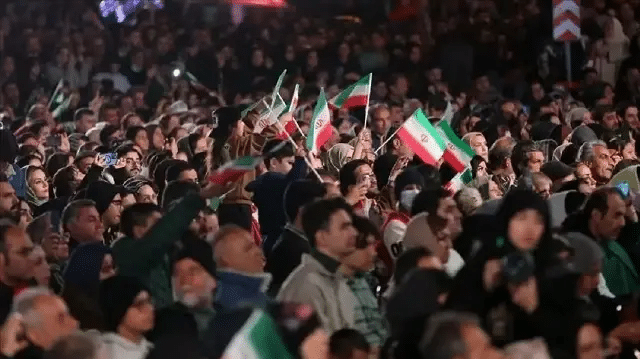
- The 1979 Iranian Revolution: Unfolded in a familiar pattern seen in other revolutions. Initially, a broad anti-Shah coalition emerged, uniting liberals (such as Bazargan and the National Front), leftists (including the Tudeh Party and the Mujahideen), and Islamists under a common cause. Khomeini’s Islamist faction skillfully leveraged this alliance to overthrow the monarchy. Once in power, they systematically sidelined, banned, or executed their former allies—first targeting the liberals, then the leftists, and finally ethnic autonomists like the Kurds. The U.S. embassy hostage crisis and the Cultural Revolution served to accelerate and legitimize this purge. In a process reminiscent of the Nazi Gleichschaltung—centralizing power through tactics like Taqiye, Ketman, and Khode’a—and echoing the violence of the Night of the Long Knives, what began as a diverse opposition front was transformed into a rigid theocratic monopoly, eliminating all dissent and consolidating absolute control.
In each case, the “big tent” alliance was a temporary measure to defeat an immediate enemy (fascism, the KMT, or reactionary forces). Once the balance of power shifted, communists moved to dismantle the coalition and eliminate rivals, often with severe consequences for their former partners.
Fascist corporatism was fundamentally exclusive, encapsulated by Mussolini’s dictum: “Everything within the state, nothing outside the state, nothing against the state.” This system sought to resolve class conflict by organizing both labor and capital into state-controlled syndicates, subordinating all interests to the nation. While corporatism was promoted as a “third way” that supposedly balanced the needs of workers and employers, in practice it only emerged after the Fascists seized power through the March on Rome, outlawed opposition parties, and violently suppressed socialists and liberals. Rather than fostering pluralism, corporatism enforced integration through rigid hierarchy and state dominance.
Similarly, the early Nazi Party was a coalition of disparate elements, including Strasserite “left” Nazis, traditional conservatives, and militant street fighters. However, once in power, Hitler swiftly consolidated control through events like the Night of the Long Knives and the process of Gleichschaltung, which eliminated internal rivals and enforced ideological conformity. The Nazi vision of the Volksgemeinschaft, or “people’s community,” was defined not by inclusion, but by the systematic exclusion and persecution of those deemed outsiders or enemies of the state. Both fascist regimes thus built unity not on diversity, but on enforced hierarchy and the suppression of dissent.
The distinction between tents, scaffolding, and true architecture is not just semantic—it is fundamental to understanding the nature of political order. A tent or scaffolding, by definition, is non-architectural: it lacks foundations, is designed for impermanence, and serves a transient purpose. Architecture, on the other hand, is rooted in the intention to endure. It is built on solid foundations, engineered to withstand the tests of weather and time, and meant to outlast its creators. When we confuse temporary structures—like tents or scaffolds—with genuine architecture in politics, we invite instability and distortion of power.
A tent provides shelter for a season; scaffolding grants access during construction. Both are meant to be dismantled once their immediate purpose is fulfilled. If we treat these as permanent political forms, the result is predictable: power becomes deformed, institutions become fragile, and governance devolves into either endless improvisation under charismatic demagogues or the quiet entrenchment of oligarchs behind the scenes.
True political architecture is defined by its foundations: written limits on power, independent institutions, clear mechanisms for succession, and systems of accountability that do not depend on any single leader or fleeting coalition. These are the load-bearing elements that ensure stability and continuity. Tents and scaffolding may be necessary during moments of crisis or transition but mistaking them for the finished structure leaves society vulnerable to manipulation and decay.
This is the crucial point, and it applies no matter who is pitching the tent or assembling the scaffolding. Citizens must demand constitutional foundations and enduring principles—limited government, separation of powers, equal protection under the law, recognition of individual rights that precede the state, and accountability mechanisms that persist beyond any particular regime. Rhetorical promises of inclusion or progress, without these structural guarantees, are no substitute for real architecture. A tent is not a building; scaffolding is not a home. When political language emphasizes broad inclusion but fails to specify the rules that bear the weight of governance, it invites people to inhabit something inherently unstable and temporary.
The Last Word: Constitutional principles serve as the enduring framework of governance—they establish clear boundaries for the exercise of power, dictate the mechanisms for its transfer, and provide impartial means for resolving conflicts without resorting to violence or personal allegiance. These principles are intentionally impersonal, designed to apply equally to all, regardless of who holds office. A robust constitution restrains both allies and adversaries, ensuring that the system does not rely on the virtue, popularity, or charisma of its current leaders. In contrast, appeals to “big tents,” “unity,” “the people,” or “broad coalitions” are inherently personal and contingent. Such rhetoric is effective only as long as the prevailing emotional or political climate persists. When those circumstances shift, these appeals offer no lasting safeguard or stability. Ultimately, it is the impersonal architecture of constitutional principles—not the fleeting bonds of personality or popularity—that preserves liberty and order through changing times.