Skip to content
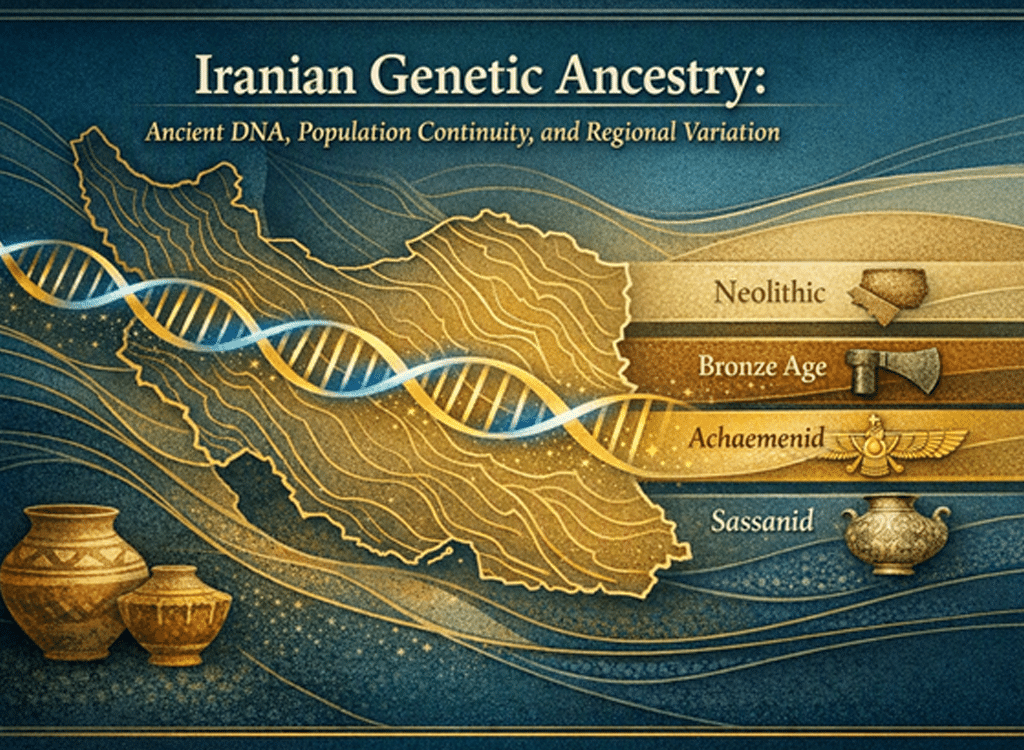
Iranian Genetic Ancestry: Ancient DNA, Population Continuity, and Regional Variation
This overview treats genetic ancestry as distinct from cultural, linguistic, national, or personal identity. It focuses on population-level patterns drawn from ancient DNA, genome-wide studies, and formal ancestry modeling, rather than on individual identity claims, political narratives, or simplified commercial ancestry labels.
Modern Iranian genetic ancestry is complex, regionally variable, and best understood through ancient DNA and genome-wide studies of contemporary populations rather than through simplistic percentage claims. The scientific literature does not support a single fixed figure such as “99% Persian,” uniform “25/60/75% Persian,” or a primary “Mediterranean with equatorial origin.” Instead, the evidence points to substantial continuity with ancient populations of the Iranian Plateau, layered with variable but generally secondary admixture from neighboring regions, and meaningful genetic differences among Iran’s ethnic and regional groups.
Across the cited literature, the most consistent pattern is not a single “Persian percentage” but a set of recurring ancestry sources: a dominant Iranian Plateau or Zagros-related component; a closely related Caucasus Hunter-Gatherer component; varying Anatolian or Levantine-related ancestry, especially in western regions; modest Steppe-related ancestry associated with Bronze Age movements; and smaller, region-specific inputs such as Central Asian, South Asian, or African-related ancestry in particular communities.

Figure 1. Illustrative synthesis of recurring ancestry sources discussed in the literature; exact proportions vary by population, reference set, and modeling method.
Early Neolithic genomes from the Zagros region, including Ganj Dareh individuals dated to roughly 10,000–8,000 years ago, represent a distinct population that diverged early from Anatolian and Levantine Neolithic farmers. These Zagros-related groups are frequently modeled as carrying high Basal Eurasian ancestry, often in the broad range of about 48–66%, together with ancestry related to Ancient North Eurasian or related lineages. In modern comparisons, they show especially strong affinities to Iranian Zoroastrians, followed by other Iranian groups such as Fars, Balochi, and some neighboring populations in Pakistan, Afghanistan, and the Caucasus (Lazaridis et al., 2016).
Chalcolithic and later populations on the Iranian Plateau typically appear to derive most of their ancestry from an Iranian Neolithic or Zagros-related substrate, often modeled together with closely related Caucasus Hunter-Gatherer ancestry. Western Plateau groups tend to show more Anatolian Neolithic Farmer or Levantine-related ancestry, with some Chalcolithic western samples modeled at roughly 20–27% for those western-related components. Eastern Plateau and adjacent Bronze Age groups often retain higher Zagros-related proportions, reaching around 65% in some models. The exact values vary by model, but the directional pattern is consistent: the Plateau was not genetically uniform, and regional ancestry profiles already differed in prehistory.

Figure 2. Illustrative regional variation in broad ancestry components reported across models; values should be read as ranges and directional patterns, not fixed ethnic percentages.
A 2025 ancient-DNA study of the northern Iranian Plateau, covering samples from the Copper Age through the Sassanid period, reported strong genetic continuity across at least three millennia. Its individuals span roughly 4700 BCE to 1300 CE, and historical-period samples from Achaemenid through Sassanid contexts largely preserve the Iranian Neolithic and Caucasus-related substrate. In supervised analyses, Iron Age northwest groups retain a combined Iranian Neolithic plus Caucasus-related component of roughly 45–51% or higher, while Bronze Age Steppe ancestry remains comparatively minor in the northern historical samples examined. Modern Fars and Mazandarani samples align closely with this ancient variation, reinforcing the conclusion that continuity and regional structure are more accurate than purity claims (Ala Amjadi et al., 2025).

Figure 3. Timeline-style summary of the 2025 northern Iranian Plateau ancient-DNA study, highlighting sample scope and reported long-term continuity.
A major genome-wide study of 1,021 individuals from 11 Iranian ethnic groups identified a Central Iranian Cluster, often abbreviated CIC, comprising largely overlapping genetic diversity among Persians or Fars, Lurs, many Kurds, Mazandarani, Gilaki, Iranian Arabs, Azeris in some analyses, and Zoroastrians. This cluster supports a model of largely autochthonous development within Iran, with long-standing continuity and a distinct Iranian-related ancestral component visible in ADMIXTURE analyses. Peripheral or more historically admixed groups, including Turkmen, some Baloch, and Persian Gulf Islanders, show additional inputs that reflect Iran’s regional contacts rather than a single national genetic profile (Mehrjoo et al., 2019).
Steppe pastoralist-related ancestry, often associated with Bronze Age Indo-Iranian expansions, is present in many Iranian and Iranic-speaking groups but is generally a secondary component within the Central Iranian Cluster. In many models, Persians, Kurds, Lurs, and related groups fall in a broad range of roughly 10–20% Steppe-related ancestry, although estimates vary by reference set and are higher in some Central Asian Iranic populations. This pattern suggests that Indo-Iranian languages spread over a largely local genetic substrate rather than through wholesale population replacement. Other ancestry inputs are more regionally concentrated: East Asian-related ancestry appears mainly among Turkmen, while minor Sub-Saharan African ancestry is most visible in some southern coastal, Arab, or Persian Gulf Islander communities and is usually interpreted as historical gene flow linked to Indian Ocean trade and slavery (Mehrjoo et al., 2019; Ala Amjadi et al., 2025).
Formal models such as qpAdm often fit Iranian populations as combinations of Zagros farmer or Iranian Neolithic ancestry, Caucasus Hunter-Gatherer ancestry, and smaller Natufian, Levantine, Steppe, or other regional components depending on the population being analyzed. These models generally place Iranians, especially core Plateau groups, closer to a Caucasus–Iranian Plateau–South-Central Asian continuum than to a simple Mediterranean category. Some studies also estimate elevated Basal Eurasian ancestry in Iran, around 38% in certain models, but that figure describes a deep statistical component rather than a modern ethnic identity (Lazaridis et al., 2016; Mehrjoo et al., 2019).
Addressing common ancestry claims
Commercial ancestry reports and simplified ADMIXTURE plots that label a component “Persian” or assign values such as 25%, 60%, or 75% are highly dependent on the reference panel, algorithm, and time depth being modeled. A modern “Persian” component usually reflects similarity to present-day comparison samples, not a direct measurement of ancient Persian ancestry. For deep ancestry, the more informative description is a mixture of dominant Iranian Neolithic or Zagros-related ancestry, closely related Caucasus ancestry, variable Anatolian or Levantine ancestry, modest Steppe ancestry, and smaller region-specific inputs.
The claim “99% Persian” is not supported by population-genetic data. The evidence does show substantial continuity with ancient populations of the Iranian Plateau and a recognizable Iranian-related genetic profile, but “Persian” is primarily a linguistic, cultural, and historical identity rather than a fixed biological percentage. Genetic studies show layered admixture over millennia and measurable variation among groups within Iran, so absolute purity claims are best understood as political or popular simplifications rather than scientific conclusions.
Figures such as “25%,” “60%,” or “75% Persian” usually come from a particular ADMIXTURE analysis, commercial DNA test, or model that treats modern Persian samples as a reference cluster. They are not standardized scientific values and cannot be generalized across all Iranians. Deep ancestry is better described as a combination of a dominant Iranian Neolithic or Zagros-related substrate, closely related Caucasus ancestry, variable Anatolian or Levantine ancestry, modest Steppe ancestry, and smaller inputs that differ by ethnic group, region, and modeling method.
The phrase “Mediterranean with equatorial origin” is not a standard population-genetic description of Iranians. Iranians share deep West Eurasian ancestry with many ancient Near Eastern and Mediterranean populations, including Basal Eurasian-related ancestry, but they are more accurately situated along an Iranian Plateau, Caucasus, and South-Central Asian continuum than in a primarily southern European or Levantine “Mediterranean” category. There is no evidence for a major Sub-Saharan African or equatorial origin in core Iranian populations; African-related ancestry is generally minor, historically recent, and concentrated in particular southern coastal or Gulf-associated groups.
Nuances, caveats, and interpretation limits
Uniparental markers, including Y-chromosome and mtDNA lineages, show a mix of West Eurasian lineages, consistent with both local continuity and later gene flow. Common examples include Y-chromosome haplogroups J2, G, R1a, R1b, and L, along with mtDNA lineages such as H, U, J, T, and HV. Frequencies vary by region and group.
Ethnic and geographic variation is important: northern and western groups often show more Caucasus- or Anatolian-related influence, southeastern groups show more South Asian affinity, and some Turkic-speaking or southern groups show additional Central Asian or African-related components.
Modeling results depend on the reference populations and statistical methods used, including qpAdm, ADMIXTURE, f-statistics, and haplotype-sharing approaches. Different studies may emphasize slightly different proportions for the same broad components.
Genetic continuity does not imply cultural or linguistic stasis. Indo-Iranian languages spread onto a largely local genetic base, while later historical events, including Arab conquests and Turkic migrations, left detectable but usually secondary genetic traces in most groups.
In short, the scientific literature portrays modern Iranians as primarily descended from populations long resident on the Iranian Plateau, with strong continuity from Neolithic and later ancient populations and additional admixture from neighboring West Asian, Steppe, Central Asian, South Asian, or African-related sources depending on region and community. Claims of near-total genetic purity, fixed “Persian” percentages, or major equatorial origins are not supported by the evidence. The most rigorous interpretation comes from ancient-DNA studies, genome-wide sampling across Iranian ethnic groups, and formal modeling frameworks such as qpAdm and f-statistics, rather than from commercial ancestry labels or popular summaries.
References
Ala Amjadi, M., Özdemir, Y. C., Ramezani, M., Jakab, K., Megyes, M., Bibak, A., Salehi, Z., Hayatmehar, Z., Taheri, M. H., Moradi, H., Zargari, P., Hasanpour, A., Jahani, V., Sharifi, A. M., Egyed, B., Mende, B. G., Tavallaie, M., & Szécsényi-Nagy, A. (2025). Ancient DNA indicates 3,000 years of genetic continuity in the Northern Iranian Plateau, from the Copper Age to the Sassanid Empire. Scientific Reports.
Lazaridis, I., Nadel, D., Rollefson, G., Merrett, D. C., Rohland, N., Mallick, S., Fernandes, D., Novak, M., Gamarra, B., Sirak, K., Connell, S., Stewardson, K., Harney, E., Fu, Q., Gonzalez-Fortes, G., Jones, E. R., Roodenberg, S. A., Lengyel, G., Bocquentin, F., Gasparian, B., Monge, J. M., Gregg, M., Eshed, V., Mizrahi, A.-S., Meiklejohn, C., Gerritsen, F., Bejenaru, L., Blüher, M., Campbell, A., Cavalleri, G., Comas, D., Froguel, P., Gilbert, E., Kerr, S. M., Kovacs, P., Krause, J., McGettigan, D., Merrigan, M., Merriwether, D. A., O’Reilly, S., Richards, M. B., Semino, O., Shamoon-Pour, M., Stefanescu, G., Stumvoll, M., Tönjes, A., Torroni, A., Wilson, J. F., Yengo, L., Hovhannisyan, N. A., Patterson, N., Pinhasi, R., & Reich, D. (2016). Genomic insights into the origin of farming in the ancient Near East. Nature, 536, 419–424.
Mehrjoo, Z., Fattahi, Z., Beheshtian, M., Mohseni, M., Poustchi, H., Ardalani, F., Jalalvand, K., Arzhangi, S., Mohammadi, Z., Khoshbakht, S., Najafi, F., Nikuei, P., Haddadi, M., Zohrehvand, E., Oladnabi, M., Mohammadzadeh, A., Hadi Jafari, M., Akhtarkhavari, T., Shamsi Gooshki, E., Haghdoost, A., Najafipour, R., Niestroj, L.-M., Helwing, B., Gossmann, Y., Toliat, M. R., Malekzadeh, R., Nürnberg, P., Kahrizi, K., Najmabadi, H., & Nothnagel, M. (2019). Distinct genetic variation and heterogeneity of the Iranian population. PLOS Genetics, 15(9), e1008385.