Skip to content

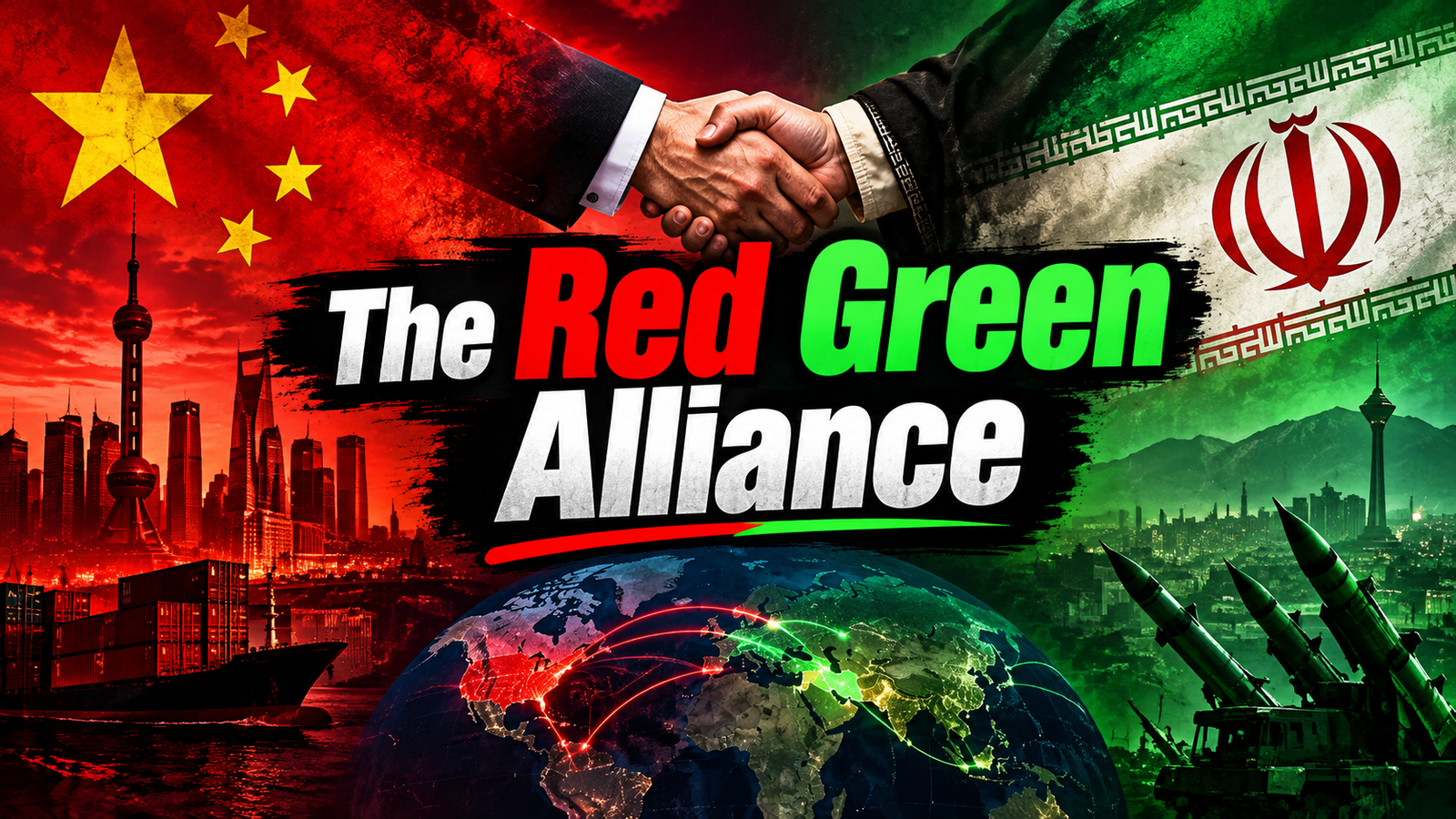
The Red-Green Alliance: How Progressives Became Islamism’s Useful Idiots
Introduction
Khomeini once declared that God should rule the world and that the Islamic Republic must export its revolution by any means necessary. This vision has been pursued through war, proxy conflicts, soft revolutions, and ideological campaigns. The regime has funded Shia communities to serve as foot soldiers, extending its influence from Africa’s “Isle of Hope” to the Sahara. It has financed the inclusion of Shia doctrines in school curricula, encouraged mass migration to Europe, and supported the conversion of Sunni Muslims to Shia Islam. Over the past 47 years, Europe has witnessed terror attacks and demonstrations linked to these efforts, with fresh incidents still occurring in France and other European countries.
Khomeini, however, was not the first to advocate exporting revolution. Before him, Lenin, Stalin, and Mao promoted similar strategies, initiating soft revolutions aimed at capturing the hearts and minds of the younger generation. There has even been a coalition of sorts between “red” (communist) and “green” (Islamist) movements, advancing socialism under the banners of democracy and progressive politics, particularly within universities and among students. Grants, scholarships, and exchange programs have been used as tools of influence, especially in Europe and America.
Meanwhile, the number of Muslim and Islamic centers and mosques has grown exponentially in recent years. None of this advances on its own, however: at every step it has been met by Western progressives who — wittingly or not — provide the legitimacy, the platforms, and the political cover, just as earlier generations of fellow-travelers once did for communism. In contrast, how many new churches have been established in Iran, Saudi Arabia, or Yemen in the past five years? Virtually none.
“How many new churches have been established in Iran, Saudi Arabia, or Yemen in the past five years? Virtually none.”
So what are the driving forces behind these soft revolutions?
Let us systematically examine the documented events, timelines, and consequences surrounding Khomeini’s doctrine of “exporting the revolution” (sodur-e enghelab) and reassess both its immediate and long-term impacts. From the outset, Khomeini and the leadership of the Islamic Republic made the export of their revolutionary model a central pillar of state policy. This was not a marginal or rhetorical stance: it was articulated repeatedly in official statements, embedded in regime strategy, and operationalized through a combination of military, ideological, and demographic tools.
Khomeini’s vision was explicit: “We shall export our revolution to the whole world. Until the cry ‘There is no God but God’ resounds over the whole world, there will be struggle… Establishing the Islamic state world-wide belongs to the great goals of the revolution.” He emphasized not only direct action but also the use of propaganda, unofficial channels, and the empowerment of sympathetic local actors to replicate the Iranian model abroad. This approach was later echoed and expanded by figures such as Qassem Soleimani, who cited the spread of Iranian influence from the Gulf to the Levant, Yemen, and into Africa as evidence of the revolution’s export.
“Establishing the Islamic state world-wide belongs to the great goals of the revolution.”
The regime’s strategy drew on precedents from other twentieth-century revolutionary movements — Lenin’s Comintern, Stalin’s internationalism, and Mao’s global outreach — combining hard power with ideological and institutional infiltration. The use of soft power, particularly in targeting youth and educational institutions, mirrors tactics seen in other revolutionary contexts. Nor are the demographic and institutional asymmetries that facilitate such influence merely theoretical; they are well documented.
Direct and Proxy Military Action: Iran has supported and, in many cases, created proxy forces such as Hezbollah in Lebanon, Shia militias in Iraq, the Houthis in Yemen, and other groups across the region. These proxies serve both as instruments of Iranian influence and as models for local revolutionary movements.
Soft Power and Ideological Outreach: Institutions like Al-Mustafa International University — established under Khomeini and expanded under Khamenei — have become hubs for training non-Iranian clerics and missionaries. With branches in dozens of countries, Al-Mustafa has played a key role in spreading Iranian religious and political ideology. In Africa, for example, it has operated in approximately 30 countries, establishing schools, seminaries, and outreach centers. The Islamic Movement of Nigeria (IMN) is a notable case, in which Shia numbers reportedly grew from negligible levels before 1979 to millions today, following sustained Iranian engagement.
Funding, Institutional Support, and Curricular Influence: Iran has provided financial incentives and institutional backing to local Shia communities, influenced curricula where possible, and engaged in targeted outreach — including, in some cases, to Sunni populations. While Iranian claims of mass conversions are exaggerated, the tangible expansion of institutional networks and influence is well-documented.
Official Iranian analyses frame these activities as both a religious obligation and a strategic imperative, rooted in the doctrine of velayat-e faqih (guardianship of the jurist), anti-imperialism, and preparation for broader Islamic governance. This mission is not limited to cultural exchange; it encompasses a comprehensive effort to reshape societies and political orders in line with the revolutionary model.
The aftermath and ongoing consequences of this policy are significant. The export of the revolution has contributed to regional instability, the proliferation of armed non-state actors, and the entrenchment of Iranian influence across the Middle East and parts of Africa. It has also provoked countermeasures from rival states and international actors, fueling cycles of conflict and competition that continue to shape the geopolitical landscape.
Demographics, Mosques, and Asymmetry
Muslim population growth in Europe is fueled primarily by immigration — including family reunification and asylum seekers — as well as by higher fertility rates compared to the native population. According to Pew Research, the Muslim share of Europe’s population was about 4.9% in 2016. Under medium-migration scenarios, this proportion is projected to rise to approximately 11% by 2050, with even higher figures possible if migration remains elevated. Notably, even in scenarios where migration ceases entirely, the Muslim population is expected to grow, owing to a younger age structure and higher birth rates. More recent Pew data indicates that the absolute number of Muslims in Europe continued to increase, reaching around 46 million by 2020 when broader definitions of Europe are used.
This demographic shift is mirrored by a rapid increase in the number of mosques and Islamic centers across Europe. Sweden, for example, had only about seven permanent mosques around the year 2000; today that number has surged to roughly 300. Spain has seen its mosques nearly double since 2011, now totaling between 1,945 and 2,000. The United Kingdom hosts approximately 2,200 mosques, France has over 2,500, and Germany counts around 2,600. The funding for these institutions often comes from foreign sources, including Saudi Arabia, Qatar, Turkey (notably through the Diyanet), and Iran. In stark contrast, many Christian churches across Europe are closing or experiencing stagnation, a trend driven by secularization and shifting demographics.
The situation is markedly different in several Muslim-majority countries. Saudi Arabia, for instance, prohibits any public Christian churches. In Yemen, ongoing conflict and societal hostility mean that virtually no churches are functioning. Iran allows a limited number of registered churches — estimated at 600 to 700 — primarily serving recognized ethnic minorities such as Armenians and Assyrians. However, public evangelism and conversion from Islam are strictly forbidden and subject to harsh penalties, forcing many Christian converts to worship in secret house churches under constant threat. New public Christian institutions, especially those open to converts, are essentially nonexistent in these environments.
A notable phenomenon in contemporary Europe is the tactical convergence between radical leftist groups and Islamist networks, sometimes referred to as the “red-green” or Islamo-leftist alliance. This is not a formal merger but rather a pragmatic alignment based on shared opposition to the Western liberal order, Israel and Zionism, and certain cultural norms. The alliance is visible in university activism (such as the BDS movement and campus protests), within political parties (notably elements of France’s La France Insoumise, segments of the European Greens, and parts of the UK Labour Party under specific leadership), and in street demonstrations. French officials and analysts have coined the term Islamo-gauchisme to describe this overlap, and similar patterns are observed in Germany, the UK, and North America. The cooperation is facilitated by shared narratives of victimhood and anti-Western sentiment, even amid significant differences in social values, such as on gender and LGBT issues. The influence of petro-dollar funding, diaspora networks, and Western multicultural policies — which often frame criticism as bigotry — further amplifies this dynamic.
Europe has also experienced repeated Islamist terror attacks and large-scale demonstrations over the past several decades. These events are consistent with both jihadist ideology and broader patterns of political mobilization, underscoring the complex and sometimes contentious interplay between demographic change, religious institutions, and ideological movements across the continent.
Driving Forces Behind the Soft Revolution
The momentum behind the so-called “soft revolution” is propelled by a complex web of interconnected factors, each reinforcing the others and accelerating the pace of change. These driving forces include:
Ideological Commitment: At the core lies a deep-rooted ideological drive. Political Islam — whether in its Shia revolutionary form, as seen in Iran, or in various Sunni manifestations such as those influenced by the Muslim Brotherhood or Salafi movements — regards the pursuit of global Islamic governance or influence as a religious obligation. For regimes like Iran, this is not merely a grassroots aspiration but an explicit state policy, guiding both domestic and foreign agendas.
Demographic Dynamics: Demography acts as a silent but powerful engine. Higher fertility rates within Muslim communities, combined with sustained patterns of immigration, often result in rapid population growth that outpaces the rate of assimilation in many Western societies. This demographic momentum can quickly create sizable communities with distinct identities, sometimes leading to the formation of parallel societies.
Resource Mobilization: Substantial financial resources, particularly from oil-rich states such as Iran and the Gulf monarchies, are strategically deployed to support the spread of influence. These funds finance the construction of mosques, religious schools, media outlets, scholarships, and political organizations, both in Muslim-majority countries and abroad, amplifying the reach and impact of ideological networks.
Western Institutional and Cultural Openings: Since the 1960s and 1970s, Western societies have increasingly embraced multiculturalism, open-border immigration policies, and a left-leaning intellectual climate in universities and media. These trends often prioritize cultural pluralism over assimilation, frame resistance to ideological expansion as “Islamophobia,” and provide grants, exchange programs, and platforms for advocacy. Such environments lower the barriers to establishing parallel institutions and facilitate the shaping of public narratives.
It is crucial to distinguish between private religious practice and the organized, often state-directed, export of political Islamism. Nonetheless, the observable pattern — marked by one-way institutional expansion, demographic transformation, and ideological penetration — bears resemblance to other historical examples of revolutionary export. The lack of reciprocity, highlighted by the severe restrictions on Christian institutions in countries like Iran, Saudi Arabia, and Yemen, further underscores the asymmetrical nature of this process.
“It is crucial to distinguish between private religious practice and the organized, often state-directed, export of political Islamism.”
A deep understanding of history and a careful review of past events serve as the most effective teachers, providing concrete evidence of performance, legitimacy, and, ultimately, accountability. The post-1960s era of immigration and multiculturalism in Western societies was launched with high hopes: seamless integration, economic advancement without radicalization, and mutual cultural adaptation. The actual outcomes, however, have often fallen short of these aspirations. By 2010–2011, prominent European leaders such as Angela Merkel, David Cameron, and Nicolas Sarkozy had publicly acknowledged the shortcomings of multiculturalism, declaring its failure in various forms.
The results have included the persistence of parallel societies, increased rates of Islamist terrorism, high-profile grooming scandals, a resurgence of antisemitism, and significant demographic changes. Pew Research has documented the rising share of Muslim populations in Europe, driven by both migration and higher fertility rates, even under scenarios of reduced migration. In contrast, settler societies like Canada and Australia, which employ selective, points-based immigration systems, have generally experienced more successful integration than much of Western Europe. There, policies such as non-discretionary family reunification, broad asylum rules, and generous welfare provisions have interacted with culturally distant inflows, often complicating integration efforts.
Turning to historical precedents, the Barbary Wars provide an instructive example. After American independence (primarily from the 1780s to 1815), U.S. ships and crews were seized by Algerian and other North African corsairs, and the U.S. Congress authorized payments to secure their release. John Adams advocated for pragmatic tribute payments, arguing they were less costly than building a navy; Thomas Jefferson opposed this approach, believing it would only encourage further demands, and preferred military action. Early administrations paid tribute, but as president, Jefferson refused additional demands from Tripoli and initiated the First Barbary War. The Tripolitan envoy justified the attacks on the grounds of Islamic law against non-submitting nations — a rationale consistent with the state practices of the era, as European powers also paid tribute. Eventually, naval power replaced this system. While not directly analogous to modern mass migration, this episode illustrates early American encounters with Mediterranean Muslim maritime predation and the enduring debate between appeasement and force.
“…the enduring debate between appeasement and force.”
In more recent history, U.S. policy toward Iran has reflected similar dilemmas. President Carter’s approach included human-rights pressure on the Shah and the controversial decision to admit the Shah for medical treatment, followed by the ensuing hostage crisis — an episode widely seen as emboldening revolutionary forces. Subsequent administrations continued patterns of accommodation or restraint: Obama’s Iran nuclear deal, his policies on Syria and Libya, and the Biden administration’s border and Afghanistan strategies have all been criticized for failing to deter expansionist actors. The Trump administration implemented travel restrictions, tightened some enforcement measures, and brokered the Abraham Accords, but did not fundamentally reverse the broader post-1965 immigration framework. Despite changes in rhetoric and emphasis, there has been significant continuity across administrations, with no full-scale reversal of the established trajectory.
Why Policies Persist Despite Evidence of Shortfalls
Despite mounting evidence of policy shortcomings, several interconnected dynamics ensure the persistence of current approaches:
Elite Incentives: Economic and political elites have strong motivations to maintain the status quo. Business sectors benefit from access to lower-cost labor, which helps maximize profits and maintain competitiveness. Left-leaning political parties, meanwhile, often secure reliable electoral blocs and accrue moral legitimacy by championing high immigration and group-rights narratives. International organizations and judicial bodies further constrain rapid policy shifts through the enforcement of human-rights and non-refoulement obligations. In this environment, immediate benefits — such as GDP growth, electoral gains, and virtue signaling — tend to outweigh the more diffuse, long-term social costs, which are disproportionately borne by working-class natives and marginalized communities.
Institutional and Ideological Entrenchment: Since the 1960s, universities, media outlets, and NGOs have increasingly promoted multiculturalism, anti-nationalism, and identity-based frameworks. Public debate is frequently stifled by accusations of racism or “Islamophobia,” discouraging open discussion and dissent. Once these norms are embedded in bureaucratic procedures, educational curricula, and funding mechanisms, reversing course becomes highly challenging because of significant transaction costs and institutional inertia. Research consistently finds that multicultural policies often yield limited socioeconomic benefits, ambiguous political integration, and sometimes adverse sociocultural effects. Nevertheless, these policies endure, especially where mainstream parties refuse to adopt restrictionist stances and where institutional structures shield them from external pressures.
Ideological Alliances and Enabling Dynamics: The phenomenon of the “useful idiot” — originally describing Westerners who unwittingly advanced Soviet interests — finds a modern parallel in the alliance between progressive and Islamist actors. Progressive and far-left groups frequently provide legitimacy, media platforms, and political cover for Islamist causes, united by shared anti-imperialist, anti-Israel, and anti-Western narratives. This alliance persists even when fundamental values — such as secularism, gender equality, and free speech — stand in direct conflict with theocratic or illiberal goals. Analysts describe this as a “red-green” tactical alliance: leftist actors gain demographic strength and moral momentum in their opposition to the liberal order, while Islamist groups secure institutional footholds and reduced scrutiny. Not all progressives are consciously complicit; many are genuinely committed to ideals of open borders and group equity, or are simply risk-averse in the face of potential social stigma. Nevertheless, the practical effect is one of enabling. This dynamic mirrors earlier patterns seen with communism, though the current iteration substitutes Islamist expansionism for Soviet ambitions as the primary beneficiary.
“Not all progressives are consciously complicit; many are genuinely committed to ideals of open borders and group equity, or are simply risk-averse in the face of potential social stigma. Nevertheless, the practical effect is one of enabling.”
Let us now critically examine how certain progressive and elite-driven policies — which could have fostered greater societal cohesion had they been implemented with cultural sensitivity — have instead been leveraged in ways that undermine the very foundations that make such reforms possible. Take family reunification, for example. While often presented as a humanitarian or integrationist measure, in practice it operates as a mechanism for chain migration — a well-documented process rather than a mere talking point. Once an individual secures permanent residency or citizenship in countries like the U.S., Canada, or much of Europe, they can sponsor not only spouses and minor children but frequently parents and siblings as well. This exponentially increases migration flows beyond the original admissions, alters the skill and cultural makeup of incoming populations, and creates entrenched demographic shifts that are difficult to reverse without significant legislative overhaul.
The persistence of these policies is less about grand conspiracies and more about political myopia and the incentives of various interest groups. The immediate, concentrated benefits for these actors outweigh the long-term, diffuse costs borne by society at large — costs that include social fragmentation, pressure on public services, and challenges to assimilation.
Turning to the motivations behind Islamist violence and expansion, the popular economic-poverty narrative fails to hold up under scrutiny. Empirical evidence shows that many perpetrators of high-profile attacks in the West — such as the 9/11 hijackers, the London and Madrid bombers, and various European jihadists — came from relatively comfortable, educated backgrounds rather than abject poverty. Studies of foreign fighters joining ISIS and similar groups consistently reveal an overrepresentation of individuals with secondary or higher education compared to their home populations. Their recruitment appeals focus on religious obligation, solidarity with the global Muslim community (ummah), the implementation of sharia, and promises of spiritual reward, rather than material deprivation alone.
The case of Yemen’s Houthis further illustrates this dynamic. While material hardship is widespread in Yemen, the movement’s leadership and mobilization strategies are rooted in Zaydi revivalism, Iranian revolutionary ideology, anti-Western and anti-Saudi rhetoric, and the valorization of martyrdom. Their core objectives are doctrinal and political, not merely economic. Similar patterns are evident among Iranian proxy groups and offshoots of the Muslim Brotherhood, and throughout the history of Islamic expansion, which has often advanced under both prosperous and austere conditions when religious and political commitment was strong.
Economists and policymakers who analyze immigration or terrorism primarily through the lenses of wage effects, fiscal impacts, or poverty as a “root cause” often overlook critical factors such as selection effects, fertility differentials, cultural distance, and the power of ideological commitment. These variables offer more robust explanations for the emergence of parallel societies, differences in crime rates among certain origin groups, and persistent challenges to assimilation. A more nuanced understanding of these dynamics is essential for crafting policies that genuinely promote social cohesion and long-term stability, rather than inadvertently eroding the cultural and institutional foundations that make positive change possible.
Analysts who once predicted that prosperity or multiculturalism would produce smooth integration have been repeatedly contradicted by the empirical evidence: demographic trends (as documented by Pew), persistent terror incidents, grooming scandals, and the proliferation of parallel institutions all point to growing divergence rather than convergence. The expectation that multicultural openness would naturally yield social harmony has not been borne out in practice.
Effective solutions do exist, but their implementation is hampered by political constraints rather than technical limitations. Evidence-based policies that have delivered better integration outcomes in other countries include:
Selective, points-based immigration systems: Prioritizing applicants based on skills, language proficiency, and cultural compatibility — as seen in Canada and Australia — has produced stronger integration outcomes than the non-discretionary family-reunification and asylum systems prevalent in much of Europe.
Restricting chain migration: Imposing strict limits or temporary suspensions on extended family migration for non-citizens, with high thresholds for family entry, helps keep integration challenges manageable.
Enforcement and removal: Rapid deportation of failed asylum seekers, criminal non-citizens, and those who reject core legal norms, combined with credible border controls and interior enforcement, is essential to upholding the rule of law.
Cultural integration requirements: Mandating language and civics education, ending state support for parallel legal or educational systems, and rolling back multiculturalism policies that elevate group rights over individual assimilation are key to fostering social cohesion.
Counter-ideological measures: Defunding or restricting foreign-funded mosques and schools linked to expansionist doctrines (such as those associated with Iran, Salafism, or the Muslim Brotherhood), ensuring transparency in curricula, and recognizing jihadist ideology as a primary driver of radicalization rather than a mere symptom.
These are standard tools of sovereign governance, routinely employed by high-performing societies. The main obstacles are domestic: elite capture of institutions, judicial overreach, electoral incentives that discourage tough reforms, and lingering ideological commitments from the post-1960s era that stigmatize restriction as inherently illegitimate. The empirical record of the past fifty years is clear: open multiculturalism combined with non-selective immigration from high-fertility, high-Islamist regions leads to measurable social divergence, not convergence. Where political will exists, recalibrating policy toward selection, enforcement, and cultural confidence is entirely feasible. The real constraint is not a lack of viable options, but the absence of political resolve to implement them.
“The real constraint is not a lack of viable options, but the absence of political resolve to implement them.”
References
Pew Research Center. Europe’s Growing Muslim Population. Washington, DC: Pew Research Center, November 29, 2017. (Muslim share of Europe’s population, 4.9% in 2016; projections to 2050 under zero-, medium-, and high-migration scenarios.)
Pew Research Center. The Future of World Religions: Population Growth Projections, 2010–2050 and subsequent Pew–Templeton Global Religious Futures estimates. Washington, DC: Pew Research Center. (Absolute Muslim population of geographic Europe, approximately 46 million by 2020.)
Khomeini, Ruhollah. Islam and Revolution: Writings and Declarations of Imam Khomeini. Translated and annotated by Hamid Algar. Berkeley: Mizan Press, 1981. (Source of the declarations on exporting the revolution and establishing the Islamic state worldwide.)
Al-Mustafa International University. Official publications and institutional materials, Qom, Iran; see also studies of the university’s overseas branches, schools, and seminaries in some 30 African countries and its role in the growth of Shia communities such as Nigeria’s Islamic Movement.
U.S. Department of State. International Religious Freedom Reports (annual), and U.S. Commission on International Religious Freedom. Annual Reports. Washington, DC. (Church counts and restrictions in Iran; prohibition of public Christian churches in Saudi Arabia; conditions in Yemen; national mosque estimates for France, Germany, the United Kingdom, Spain, and Sweden as compiled from official and organizational sources.)
Merkel, Angela. Speech to the Junge Union, Potsdam, October 16, 2010 (“Multikulti ist absolut gescheitert”); Cameron, David. Speech to the Munich Security Conference, February 5, 2011; Sarkozy, Nicolas. Televised interview, TF1, February 10, 2011. (The European leaders’ declarations on the failure of multiculturalism.)
Wheelan, Joseph. Jefferson’s War: America’s First War on Terror, 1801–1805. New York: Carroll & Graf, 2003. (The Barbary Wars; the Adams–Jefferson debate over tribute versus naval force.)
Krueger, Alan B., and Jitka Malečková. “Education, Poverty and Terrorism: Is There a Causal Connection?” Journal of Economic Perspectives 17, no. 4 (2003): 119–144; and Krueger, Alan B. What Makes a Terrorist: Economics and the Roots of Terrorism. Princeton: Princeton University Press, 2007. (Evidence against the poverty-as-root-cause account of terrorism.)
Koopmans, Ruud. “Trade-Offs between Equality and Difference: Immigrant Integration, Multiculturalism and the Welfare State in Cross-National Perspective.” Journal of Ethnic and Migration Studies 36, no. 1 (2010): 1–26. (Comparative evidence on multicultural policies and integration outcomes.)