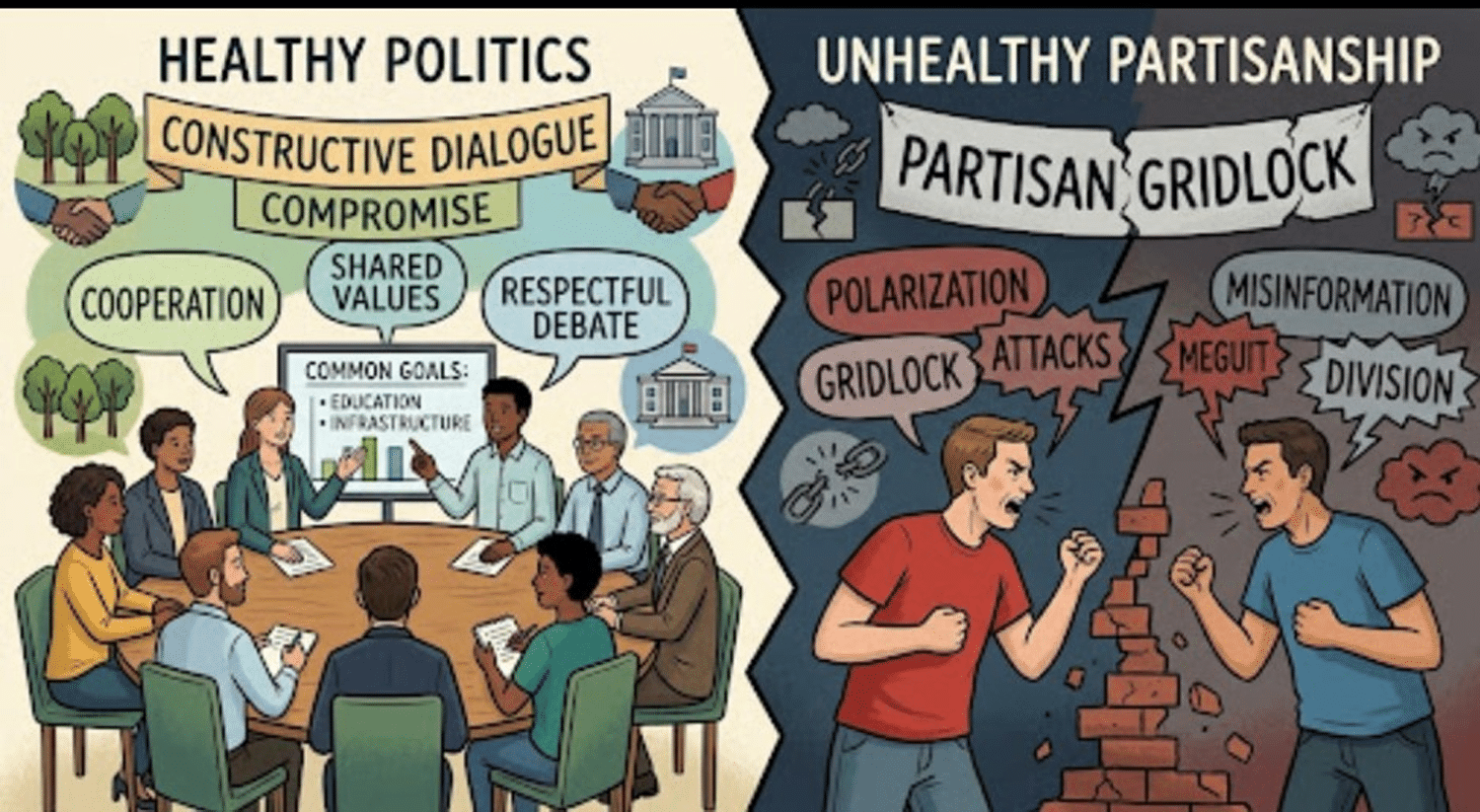
Unhealthy Politics
This year Americans mark a quarter-millennium milestone: the 250th anniversary of independence. The republic remains fundamentally strong, yet it confronts a pivotal political paradigm shift. The state of the Union is still sound, but it is deeply divided. That division is not beyond repair. Americans must demand political transparency and truth-telling as the indispensable conditions of self-government.
From the beginning the Founding Fathers faced comparable challenges and dilemmas. Profound differences existed over the nature and scope of political power, the structure of government, and the character of the political environment. Those differences sometimes descended into personal attacks and bitter disagreement. Some preferred conciliatory measures and incremental approaches; others favored harsher measures and even aggressive confrontation. The challenges were both domestic and foreign. Yet the process repeatedly produced collective bargaining and civil agreements. Participants did not systematically accuse one another of being too broad or too rigid, unpatriotic, or treasonous. They fought for America, not for personal fame or net worth. Like today’s political era, they confronted foreign adversaries—political and religious—and fierce competition from friends and enemies alike. By contemporary standards many of their decisions appear sound; a few were unjustifiably unpopular. Taken together, those decisions manufactured the America we inhabit unapologetic, patriotic, and grounded in 250 years of relative stability and democratic continuity.
America and Americans have endured at least four major wars, two pandemics, and two major financial crises, yet the democratic experiment endures. Because of that enduring framework of ordered liberty, successive generations have enjoyed freedom and freedom of choice—among the world’s strongest systems of education and healthcare, and open-ended opportunities to grow, thrive, and pursue their own visions regardless of creed, origin, sex, gender, or social status.
There is no question that, 250 years later, the great majority of our politicians and statesmen and stateswomen are patriots. Nevertheless, we are witnessing deep political divisions. Many who for generations enjoyed the generosity of democracy and freedom of choice are now subscribing to bankrupt ideologies and failed policies whose consequences include corruption, institutional decay, and social aftermath. These divisions are racing America toward a point of political instability. Some appear determined to destroy the very order that nurtured them and that made possible the social position they now occupy. Why is that?
Why the Turn Toward Destruction?
Several interlocking forces help explain the paradox.
First, prosperity itself can erode the habits that created it. When a society delivers unprecedented material security, educational access, and personal mobility, the felt urgency of civic restraint and institutional gratitude declines. Relative status anxiety replaces absolute scarcity as the dominant motivator. Individuals and factions begin to measure their condition not against the historical baseline of human existence, but against idealized or selectively remembered alternatives. The result is a politics of grievance that treats the existing constitutional order less as a hard-won achievement than as an obstacle to be dismantled.
Second, the collapse of shared historical literacy has removed the common reference points that once disciplined disagreement. The Founders could disagree ferociously over banks, treaties, or the scope of federal power because they still operated inside a shared vocabulary of natural rights, limited government, and the dangers of faction. When large portions of the educated class no longer teach or absorb that vocabulary—when the Constitution is treated primarily as a set of obstacles rather than a framework for ordered liberty—disagreement ceases to be competitive deliberation and becomes existential conflict. Accusations of treason and moral impurity become easier once the other side is no longer recognized as a fellow citizen operating under the same fundamental rules.
Third, institutional incentives have shifted. Media ecosystems, academic prestige markets, and activist funding streams reward the most extreme framings of political conflict. Nuance and compromise are commercially and socially expensive; purity tests and maximalist rhetoric are rewarded. The same dynamic appears inside parties and movements: the activists and donors who set the emotional temperature are often those least constrained by governing responsibility. Over time the Overton window of acceptable discourse moves away from the practical art of coalition-building that the Founders practiced and toward performative confrontation.
Fourth, certain ideologies now current treat politics as a zero-sum struggle for moral and institutional capture rather than as a continuous negotiation among free citizens. Closed systems that promise final solutions—whether framed in terms of historical inevitability, group identity hierarchy, or utopian redesign of human nature—have little patience for the messy, provisional character of constitutional democracy. Once politics is redefined as the struggle to impose a singular vision of justice rather than to manage competing legitimate interests under a common rule of law, the other party’s continued existence becomes intolerable. The Founders, for all their flaws, largely rejected that logic. They built mechanisms—federalism, separation of powers, staggered elections, an independent judiciary—precisely to prevent any faction from achieving permanent victory.
Fifth, the very success of the American system in absorbing successive waves of immigrants and internal minorities has created a false sense that the system is infinitely elastic. Earlier generations understood that social trust and institutional legitimacy are finite resources that must be replenished through shared norms, mutual forbearance, and a working consensus on the legitimacy of the regime itself. When large numbers of citizens begin to regard the constitutional order as illegitimate or as the property of a particular historical class, the reservoir of legitimacy drains. Those who have benefited most from the system’s openness can become its most energetic critics once they conclude that the system’s continued existence threatens their preferred moral hierarchy.
None of these dynamics is irreversible. The American political tradition contains repeated examples of recovery from periods of intense polarization—after the Alien and Sedition Acts, after the Civil War, after the upheavals of the 1960s and early 1970s. Recovery has always required a reassertion of two related disciplines: a return to factual transparency and an insistence that political opponents remain fellow citizens rather than existential enemies.
Transparency means more than formal disclosure rules. It means a cultural expectation that claims about systemic injustice, foreign threats, electoral integrity, or institutional capture must be tested against evidence that is available for public scrutiny. Truth-telling means accepting that the other side’s motives are usually mixed rather than purely malevolent, and that policy failure is more often the product of complexity and trade-offs than of conspiracy.
The Founders’ example remains instructive not because they were saints, but because they repeatedly chose institutional continuity over the temptation of permanent factional victory. They accepted that politics is the realm of the provisional. They understood that a free society cannot survive if its leading voices treat every election as the last chance to prevent tyranny and every disagreement as evidence of moral or patriotic defect.
The 250th anniversary is therefore not merely a commemorative occasion. It is a stress test. The question is whether a people who have enjoyed the longest continuous experiment in democratic self-government in modern history still possess the civic maturity to prefer the imperfect, negotiable order they inherited over the seductive promise of ideological finality. The answer will determine whether the next quarter-millennium is possible.
Footnote Citation:
“The Alien and Sedition Acts were a series of four controversial laws passed by the Federalist-controlled U.S. Congress in 1798 and signed into law by President John Adams. Driven by fears of impending war with France (the Quasi-War), the legislation aimed to restrict foreign influence and suppress domestic political opposition.
The Four Acts Breakdown
- Naturalization Act: Extended the residency requirement for U.S. citizenship from 5 years to 14 years, targeted at immigrant voters who predominantly supported the opposition Democratic-Republican party.
- Alien Friends Act: Empowered the president to deport or imprison non-citizens deemed “dangerous to the peace and safety of the United States” without a trial.
- Alien Enemies Act: Allowed the arrest and deportation of male citizens of an enemy nation during wartime. (This is the only act from the four that remains in effect today in modified form).
- Sedition Act: Made it a crime to print, utter, or publish “false, scandalous, and malicious writing” against the federal government, Congress, or the president.
Political Backlash & Aftermath
The Sedition Act sparked outrage because it directly violated First Amendment rights to free speech and press. Federalist prosecutors used the law aggressively to arrest Democratic-Republican newspaper editors, journalists, and even a sitting Congressman (Matthew Lyon).
In response, Thomas Jefferson and James Madison secretly drafted the Kentucky and Virginia Resolutions, arguing that states had the right to declare federal laws unconstitutional. Public backlash against these acts crippled John Adams’s presidency, directly contributing to Thomas Jefferson winning the election of 1800 (often called the “Revolution of 1800”).
Most of the acts were allowed to expire or were repealed by 1802.”National Archives
“The period spanning the 1960s and 1970s was one of the most transformative and tumultuous eras in modern history, characterized by intense social, political, and economic structural shifts.
Wikipedia
While the 1960s were largely defined by ideological idealism and high-visibility mass activism, the 1970s shifted into systemic disillusionment, economic distress, and institutional restructuring.
Social & Cultural Transformations
- Civil Rights to Black Power: The early 1960s focused on nonviolent direct action (sit-ins, Freedom Rides, March on Washington) led by figures like Martin Luther King Jr., culminating in the Civil Rights Act of 1964 and Voting Rights Act of 1965. By the late 1960s, frustration over systemic economic inequality sparked urban uprisings and birthed the more militant Black Power movement (e.g., Black Panther Party).
American Archive of Public Broadcasting
- The Counterculture Movement: Rejection of traditional social norms among youth manifested through the “hippie” movement, sexual revolution, music (Woodstock), and drug experimentation, challenging authority, traditional family structures, and corporate consumerism.
- Expansion of Liberation Movements: Inspired by Civil Rights activism, other marginalized groups mobilized:
American Archive of Public Broadcasting
-
- Second-Wave Feminism: Fueled by Betty Friedan’s The Feminine Mystique, the founding of NOW, and the landmark Roe v. Wade (1973) decision.
- Gay Liberation: Sparked nationwide after the 1969 Stonewall Riots in New York City.
- Red Power & Chicano Movements: Groups like the American Indian Movement (AIM) and United Farm Workers (led by César Chávez) fought for land rights, sovereignty, and labor protections.
American Archive of Public Broadcasting
-
- Environmentalism: Launched after Rachel Carson’s Silent Spring (1962), leading to the first Earth Day in 1970 and the creation of the EPA.
Political Turmoil & War
- The Vietnam War & Anti-War Movement: The U.S. military escalation in Vietnam became a central flashpoint. Mass protests, draft card burnings, and tragedies like the 1970 Kent State shootings severely divided the nation along generational and political lines.
Wikipedia
- Assassinations of Key Leaders: The 1960s were marked by political violence, including the assassinations of President John F. Kennedy (1963), Malcolm X (1965), Martin Luther King Jr. (1968), and Robert F. Kennedy (1968), eroding faith in peaceful change.
- Institutional Distrust:
- The Pentagon Papers (1971) revealed government deception regarding the scope of the Vietnam War.
- The Watergate Scandal (1972–1974) led to Richard Nixon becoming the first U.S. President to resign, cementing widespread public skepticism toward government integrity.
Economic Realities of the 1970s
- Stagflation: The robust post-WWII economic boom collapsed in the 1970s into an unprecedented combination of stagnant economic growth, high unemployment, and high inflation (“stagflation”).
- Energy Crises (1973 & 1979): OPEC oil embargoes triggered acute gas shortages, skyrocketing energy prices, and long lines at gas stations, exposing Western vulnerability to global energy markets.
- Deindustrialization: Manufacturing shifts away from traditional industrial hubs (the Rust Belt) caused structural job losses and urban decay.
Legacy
By the end of the 1970s, the progressive momentum of the 1960s met a powerful conservative counterreaction. The economic anxieties and cultural fatigue of the decade paved the way for the conservative rise of the 1980s (typified by Ronald Reagan’s presidency) while permanently broadening civil rights, legal protections, and political participation for women and minorities.”
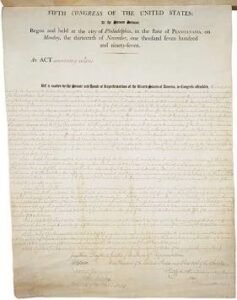
Official act passed by Congress in 1798. Source: National Archives