Skip to content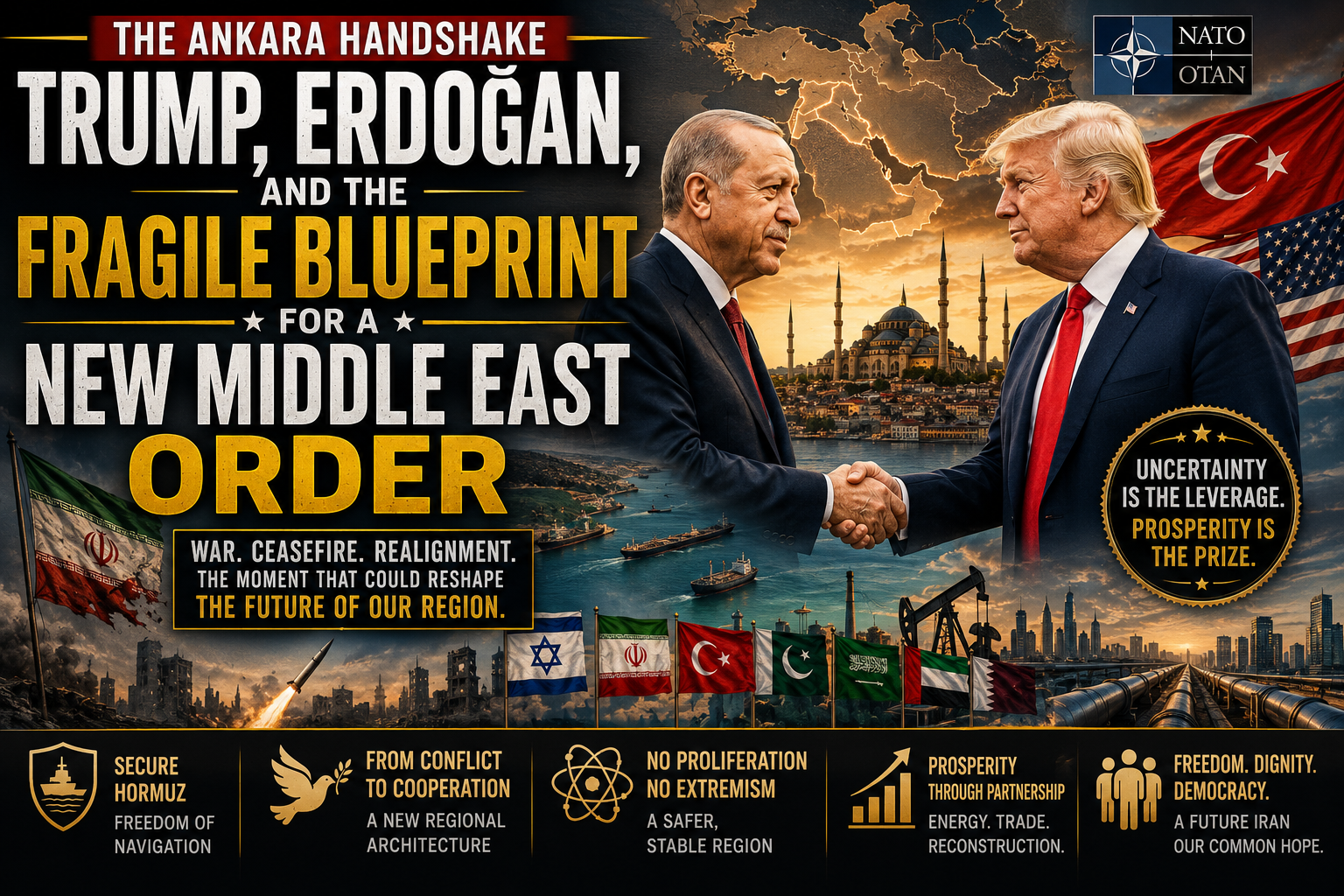
The Ankara Handshake: Trump, Erdogan, and the Fragile Blueprint for a new Middle East Order
President Donald Trump’s arrival in Ankara for the July 7–8, 2026, NATO Summit unfolded amid acute regional instability. The Strait of Hormuz remained a volatile flashpoint, with Iranian forces having attacked multiple cargo vessels in recent weeks—one sustaining extensive damage, another reportedly at risk of explosion. The Islamic Republic persisted in its daily executions of citizens, while senior officials escalated their rhetoric, issuing public threats against Trump himself, including calls for his assassination and reported bounties reaching $50 million. On the eve of the summit, an Iranian official statement circulated, claiming that while Trump was in Turkey, Iranian assets had the opportunity to strike but refrained “out of respect for our neighbors.”
Against this tense backdrop, Trump’s bilateral engagement with Turkish President Recep Tayyip Erdoğan assumed outsized symbolic and strategic significance. The optics—warm welcomes, a lavish state dinner, and Trump’s public praise of Erdoğan as a “great leader” and close partner—signaled a calculated American effort to secure Turkish alignment through a blend of personal rapport, economic incentives, and implicit pressure. The visit was closely watched by regional actors and global powers alike, as it tested whether Trump’s signature style of manufactured uncertainty and transactional deal-making could catalyze a durable realignment: one that sidelines Iran’s hardliners, integrates a transformed Iran into a broader coalition alongside Israel, Turkey, Pakistan, and key Arab states, and stabilizes critical energy corridors under U.S. leadership.
Beyond the ceremonial gestures, substantive discussions focused on deepening defense cooperation, expanding joint intelligence operations, and accelerating energy infrastructure projects designed to bypass chokepoints vulnerable to Iranian disruption. Trump’s team also floated the prospect of a multilateral security pact, aimed at deterring further Iranian aggression and reassuring nervous NATO allies. The summit’s outcome would not only shape the trajectory of U.S.-Turkish relations but also determine the balance of power across the Middle East at a moment when the stakes—diplomatic, economic, and existential—had rarely been higher.
The 2026 Iran war—initiated by the United States and Israel in late February after months of escalating tensions—profoundly reshaped the regional landscape. The joint campaign focused on decapitating Iranian leadership and crippling military infrastructure, resulting in the reported death of Supreme Leader Ali Khamenei and a significant reduction in the operational capacity of the Islamic Revolutionary Guard Corps (IRGC). In June 2026, a memorandum of understanding brokered in part by Pakistan established a tenuous ceasefire. This agreement included provisions to reopen the Strait of Hormuz to commercial shipping, initiate limited discussions on sanctions relief, and set a 60-day window for negotiations over Iran’s nuclear program. Despite these measures, the ceasefire has faced repeated challenges. Iranian drone and asymmetric attacks on maritime traffic in and around the Strait—including documented strikes on Singapore-flagged cargo vessels—have inflicted damage, disrupted evacuation and transit operations, and triggered U.S. retaliatory strikes against Iranian missile, drone, and IRGC assets.
These ongoing incidents highlight a central reality: although weakened, the Islamic Republic remains capable of significant disruption. The regime continues to employ daily executions domestically and maintains extraterritorial threats, demonstrating its reliance on ideological mobilization and asymmetric tactics even as its conventional military strength wanes. Western and regional intelligence assessments increasingly agree that the Islamic Republic, as currently constituted, is fundamentally expansionist and incompatible with stable integration into the international order. Neighboring countries—including Turkey and several Gulf states—once benefited from Iran’s economic isolation, capitalizing on oil trade rerouting and energy market distortions. However, the aftermath of the war has shifted regional incentives. There is now a marked trend toward pragmatic alignment with U.S. leadership, as states move away from previous strategies of appeasement or hedging. The new reality is defined by a cautious but clear preference for stability and collective security, even as the risk of renewed conflict remains ever-present.
Trump’s Ankara Playbook: Flattery, Leverage, and the “Prosperity Feast”
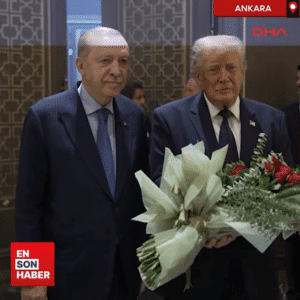
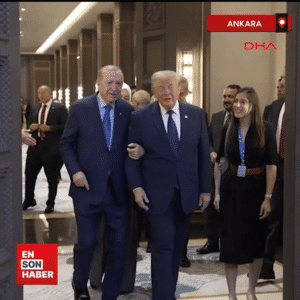
Trump arrived in Ankara amid ongoing NATO debates over defense spending targets, Ukraine support, and burden-sharing. He used the platform to criticize alliance shortfalls while pursuing bilateral gains. The centerpiece was his engagement with Erdoğan. Reports described a lavish ceremonial welcome at the Presidential Complex, followed by substantive talks. Trump publicly lauded Erdoğan’s strength, leadership, and commitment to Turkey—rhetoric that echoed earlier descriptions of the Turkish president as a “brother” or indispensable partner. Photographs of the two leaders standing shoulder-to-shoulder conveyed closeness that Turkish state media amplified.
This personal diplomacy served multiple purposes. It rewarded Erdoğan for hosting the summit smoothly and for Turkey’s relatively restrained posture during the Iran war—Ankara had positioned itself as a mediator rather than a direct participant in the U.S.-Israeli campaign. In exchange, Trump dangled concrete incentives: restoration of aspects of Turkey’s F-35 fighter jet access (previously curtailed), potential sanctions relief pathways, and broader economic integration opportunities. Turkey’s economy, burdened by inflation, currency pressures, and post-pandemic recovery challenges, stood to gain significantly from renewed Western investment and defense-industrial cooperation.
The message to Erdoğan was layered. Public praise functioned as both carrot and signal: cooperate on containing Iranian disruption (particularly Hormuz security and non-interference with Israeli operations in Lebanon and Syria) and Turkey could partake in the emerging “prosperity feast.” Implicitly, deviation—whether through renewed Kurdish adventurism in Syria or excessive alignment with hardline Iranian elements—would carry costs. Trump’s style of uncertainty amplified leverage; allies and partners could never be entirely sure where the red lines lay until tested. China received explicit praise for staying largely outside direct Middle East military entanglement despite its longstanding ties to Tehran, reinforcing a preference for actors who do not actively obstruct U.S.-led stabilization efforts.
Erdoğan arrived at the summit propelled by a web of intricate motivations. Having weathered the 2016 coup attempt—an ordeal marked by substantial Western, including Obama-era, diplomatic and intelligence involvement—he has meticulously crafted an image of resilient Islamic leadership, infused with neo-Ottoman and pan-Islamic undertones. His administration’s intervention in Syria proved pivotal: Turkish backing for opposition groups, notably those that coalesced into the Hayat Tahrir al-Sham (HTS) network under Ahmed al-Sharaa, was instrumental in the swift downfall of the Assad regime in late 2024. The emergent transitional government in Damascus, led by al-Sharaa, has benefited from Turkish military training, equipment, and steadfast political support. Ankara’s underlying agenda is clear: to neutralize Kurdish autonomy ambitions—especially those of the Syrian Democratic Forces (SDF) and any residual PKK infrastructure—while expanding Turkish influence across northern Syria and shaping the security orientation of the new Damascus authorities.
Turkey has historically viewed the prospect of a strong, secular, democratic Iran on its eastern frontier with suspicion. A contained, religiously authoritarian Iran has served Turkish interests by diverting Iranian resources inward, facilitating energy arbitrage during sanctions, and curbing Tehran’s capacity to project power into the Caucasus or Central Asia in ways that might rival Turkish aspirations. This strategic calculus has also informed Ankara’s approach to several Gulf states. However, the post-war weakening of the Islamic Republic has necessitated a strategic reassessment: persistent Iranian belligerence—manifested in Hormuz attacks, proxy operations, and internal repression—now threatens Turkey’s economic recovery and regional stature. In this context, aligning with U.S. leadership to enforce red lines, while leveraging the situation for maximum concessions, has emerged as the most pragmatic short-term strategy.
Erdoğan’s personal timeline injects further urgency into his actions. As he approaches the twilight of his political career, he is determined to secure a legacy of a Turkey that is economically dynamic, militarily formidable, and strategically indispensable to the West. Full integration into a U.S.-anchored Middle East order—encompassing defense agreements, energy corridors, and lucrative reconstruction contracts—represents the culmination of this vision. The summit’s optics, including Erdoğan’s demonstrably warm rapport with Trump, reinforced this narrative at home, signaling to domestic audiences that Turkey remains a central actor rather than a subordinate. Nevertheless, enduring frictions remain deep-seated animosity toward Israel, unresolved historical grievances with Armenia, and Erdoğan’s occasional rhetorical nods toward caliphate-era symbolism continue to complicate Ankara’s relations with both Washington and Jerusalem. Despite these challenges, Erdoğan’s maneuvering at the summit underscored his intent to position Turkey as a decisive power broker in the evolving regional order, balancing old rivalries with new opportunities.
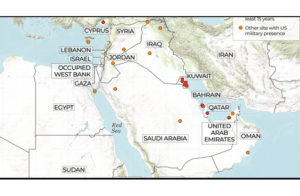
Trump’s vision, conveyed through a blend of public pronouncements and discreet diplomatic engagement, envisions a fundamentally reshaped Middle East. In this new order, key regional actors—Israel, a post-conflict or internally transformed Iran, Turkey, Pakistan, and a coalition of aligned Arab states—collaborate on security, energy, and economic integration, all under the aegis of an American security umbrella. Pakistan’s successful mediation in the June ceasefire has bolstered its credibility and justified its inclusion in this emerging framework. For Arab states, having navigated the Abraham Accords and subsequent normalization waves, the prospect of diversified partnerships offers a dual advantage: diminishing Iranian leverage while unlocking new avenues for investment and technological advancement.
The prospect of a “new Iran” remains the most uncertain yet pivotal factor. The Islamic Republic’s military setbacks, leadership attrition, and deepening economic isolation have created unprecedented openings. Possible scenarios range from a managed internal transition toward a less theocratic, more nationalist regime, to extended instability, or even a hardline retrenchment. For the coalition to solidify, Iran must demonstrate tangible changes in its nuclear posture, proxy activities, and respect for freedom of navigation in the Strait of Hormuz. Economic reconstruction incentives—strictly conditioned on verifiable compliance—could intensify internal pressures for reform. For Iranian advocates of secular democracy and national reconciliation, this juncture is fraught with both danger and opportunity: external stabilization efforts must avoid merely substituting one form of authoritarianism for another, instead fostering genuine pluralism, accountability for human rights abuses, and a process of national healing after decades of repression.
Israel’s role is indispensable. Having executed sustained operations to degrade Iranian military capabilities and enforce buffer zones in southern Syria, Jerusalem now seeks sustainable containment rather than endless confrontation. While Turkish Israeli tensions—rooted in disputes over Gaza, Syria, and historical grievances—persist, shared interests in countering Iranian influence and ensuring energy security offer pragmatic grounds for cooperation. Gulf partners, meanwhile, weigh the promise of deeper integration against the lingering threat of Iranian asymmetric retaliation.
China’s evolving posture is also significant. By steering clear of direct military involvement while maintaining robust economic and diplomatic ties with Tehran, Beijing has positioned itself as either a stabilizer or a spoiler, depending on how events unfold. Trump’s public praise for China’s restraint effectively rewarded its non-obstruction, signaling that great-power competition in the Middle East need not devolve into a zero-sum contest—so long as core U.S. interests, such as the security of Hormuz, non-proliferation, and counterterrorism, are safeguarded.
Ultimately, Trump’s approach sketches a Middle East where pragmatic cooperation, conditional incentives, and managed rivalries could yield a more stable and prosperous region—provided that the most volatile variables, especially Iran’s trajectory, are addressed with both resolve and flexibility.
Free and Secure Middle East
No realignment is guaranteed. The Hormuz ceasefire remains fragile; any renewed Iranian attacks on shipping could rapidly trigger escalation spirals involving the U.S., Israel, or Gulf states. In Syria, the al-Sharaa government’s consolidation is challenged by internal sectarian tensions, Israeli security imperatives, and persistent Turkish demands for Kurdish containment. Failure to integrate or neutralize Syria Democratic Forces (SDF ) elements risks renewed Turkish cross-border operations and significant humanitarian fallout. Meanwhile, unresolved Armenian Turkish disputes and broader historical grievances could resurface as diplomatic flashpoints if not carefully managed and ring-fenced.
Domestically, Erdoğan’s ongoing authoritarian consolidation—marked by tightened media controls, judicial influence, and pressure on opposition—continues to generate friction with Western partners who prioritize rule-of-law standards as prerequisites for deeper integration. Over-reliance on the personal rapport between Trump and Erdoğan introduces further volatility; U.S. policy continuity beyond the current administration cannot be assumed. For Iran, the principal risk is that external agreements may stabilize the regime’s core without addressing its underlying theocratic and expansionist nature, merely deferring the next crisis rather than resolving it.
A successful “prosperity feast” could accelerate Turkish economic recovery and establish Ankara as a pivotal energy and logistics hub for the region. Conversely, perceived Turkish overreach in Syria or insufficient cooperation on Hormuz could provoke renewed U.S. pressure or spark Israeli Turkish tensions. Should Iran undergo genuine political reform and participate constructively, the region’s risk calculus would be fundamentally transformed; however, continued IRGC dominance behind a civilian façade would only perpetuate proxy conflicts and ongoing nuclear brinkmanship. The regional landscape remains highly contingent, with both opportunities and dangers closely intertwined.
The Ankara summit and its surrounding diplomacy signify far more than mere transactional maneuvering; they serve as a crucible for testing whether the post-2026 landscape—marked by the military weakening of the Islamic Republic, evolving economic incentives, and a U.S. approach that fuses pressure with inducements—can yield a more resilient and equitable regional order. Such an architecture would enshrine freedom of navigation through the Strait of Hormuz, enforce verifiable constraints on Iran’s nuclear and missile ambitions, and foster inclusive economic integration that uplifts entire populations rather than simply fortifying regimes.
For Iranian citizens enduring executions, arbitrary detention, and relentless economic hardship, the stakes are nothing short of existential. A new regional framework that curtails the regime’s external reach while expanding internal political space could hasten the long-overdue transition toward secular democracy, national reconciliation, and genuine accountability for decades of crimes against humanity. Conversely, agreements that sacrifice core values for short-term stability risk entrenching a rebranded authoritarianism and betraying the memory of protesters, women, minorities, and all victims of the Islamic Republic’s repression since 1979—including those who rose up during the 2022 Mahsa Amini movement and subsequent waves of dissent.
Turkey now stands at a pivotal crossroads. President Erdoğan’s legacy will ultimately be measured not only by economic performance or territorial influence, but by whether Turkey emerges as a constructive anchor of a rules-based, pluralistic Middle East or remains ensnared in cycles of authoritarian solidarity and revisionist ambition. The decision between embracing integration into a prosperous, U.S.-aligned regional order and persisting with strategic hedging carries profound, generational consequences—not just for Turkey, but for the entire region’s trajectory toward peace, justice, and shared prosperity.
Conclusion:
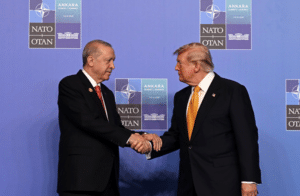
Trump’s visit to Ankara, marked by ceremonial grandeur, effusive praise, and carefully calibrated incentives, illustrates a unique brand of great-power diplomacy: manufacture enough uncertainty to focus attention, then present tangible opportunities for mutual gain to those prepared to cooperate. The nascent coalition—comprising Israel, a potentially reoriented Iran, Turkey, Pakistan, and key Arab states—offers a credible blueprint for shaping the post-war order, contingent on strict adherence to core requirements: security in the Strait of Hormuz, robust non-proliferation measures, and demonstrable behavioral reforms.
Yet, success is far from assured. Deep-seated historical animosities, internal political limitations, and the Islamic Republic’s lingering capacity for disruption all demand vigilance. Nevertheless, the alignment of military developments, economic imperatives, and diplomatic momentum has created a rare window of opportunity—one that responsible stakeholders must seize. A regional order grounded in verifiable restraint, economic integration, and respect for human dignity would mark a decisive departure from decades of theocratic adventurism and proxy conflict.
The coming months will determine whether the Ankara handshake and the broader diplomatic framework it inaugurates can yield lasting progress—or whether renewed crises in Hormuz, continued Syrian instability, or Iranian retrenchment will once again postpone the hope of genuine regional transformation. For advocates of a free, democratic, and secular Iran as the linchpin of enduring peace, the stakes are immense. The future of the region—and the security of global energy supplies—may well depend on whether this moment of leverage is harnessed for substantive, structural change, rather than dissipated in another cycle of temporary compromise. In this context, uncertainty is not merely a risk, but a catalyst: it sharpens choices, compels action, and, if wisely managed, can open the door to a more stable and prosperous Middle East.