Skip to content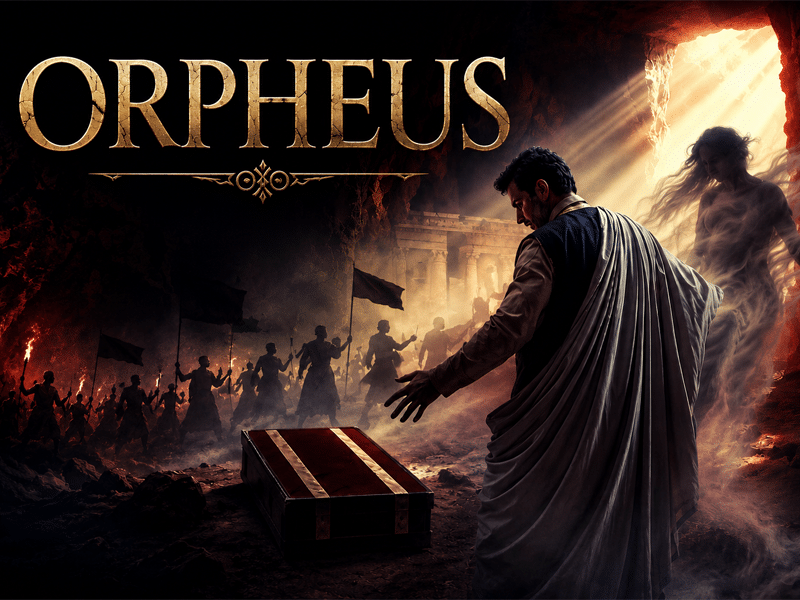
Orpheus in Tehran: How Religious Superstition Detached a Revolutionary Core from Reality

In the ancient Greek myth, Orpheus descends into the underworld to retrieve his beloved Eurydice. His music softens even Hades. The rulers of the dead grant her return on one condition: he must walk ahead and never look back until they reach the light. Overcome by doubt, longing, or the unbearable silence behind him, Orpheus turns. Eurydice vanishes forever.
The myth endures because it captures a universal human vulnerability: the inability to release what has been lost. When grief, ideology, and power fuse, that single backward glance can become a permanent posture — a refusal to emerge fully into the present.
Today, in the aftermath of Ayatollah Ali Khamenei’s assassination and the prolonged public rituals surrounding his funeral in July 2026, the Orpheus story offers a precise lens for understanding a specific segment of Iranian society: the committed ideological core that has lived for nearly half a century inside a closed bubble of religious fervor and state-sponsored superstition.
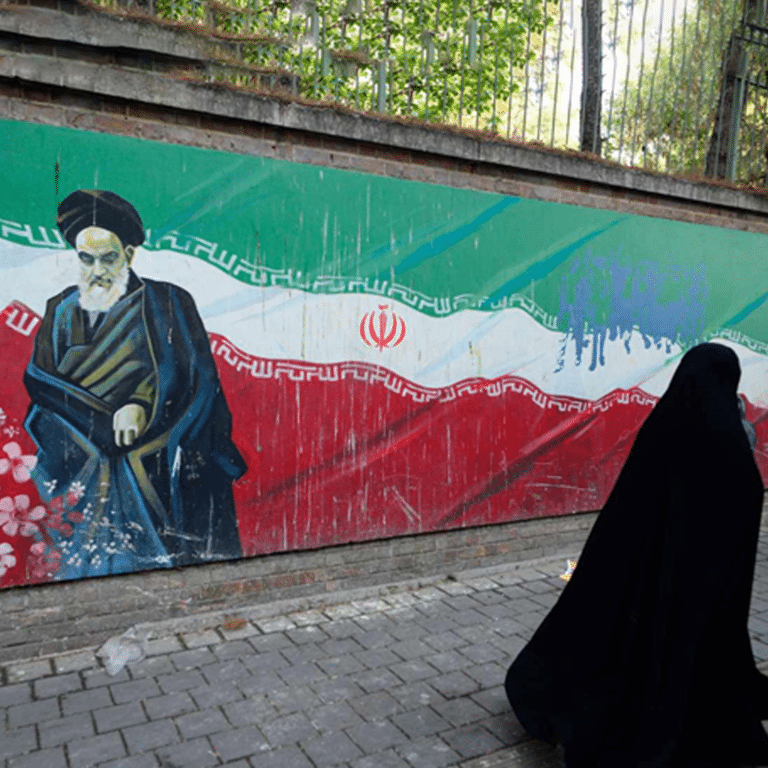
Since the 1979 Islamic Revolution, a portion of Iranian society has been immersed in an environment where religious narratives, martyrdom symbolism, and anti-imperialist eschatology became the dominant framework for interpreting reality. For this group — estimated by various surveys and observations at roughly 10–20% of the population — the world outside the bubble has grown increasingly distant.
Decades of state media, Friday sermons, school curricula, and security apparatus reinforcement created an echo chamber in which empirical contradictions could be explained away as plots by external enemies or tests of faith. Economic failures, social repression, and repeated uprisings were reframed not as signals to adapt, but as further proof of the cosmic struggle. Religious superstition — in the sense of literalist, magical, or conspiratorial thinking untethered from evidence — became not merely personal belief but a collective operating system.
Living inside such a bubble for fifty years does more than shape opinions. It alters the relationship to reality itself. Objectivity requires the capacity to update beliefs when new information arrives. In a closed system where doubt is equated with betrayal and external sources are pre-labeled as hostile, that capacity atrophies. What remains is a powerful, self-reinforcing narrative in which the past is never truly past and loss must be answered with perpetual resistance.
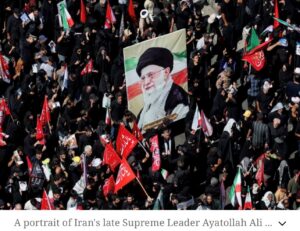
This core has long practiced a distinctive form of collective grief. The annual mourning of Imam Hussein at Karbala — now fourteen centuries old — provides the emotional and ritual template. Grief is not private or time-limited; it is public, cyclical, and politically generative. When Ayatollah Khamenei was killed in February 2026, the same emotional infrastructure was activated and extended.
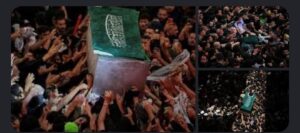
The funeral processions, delayed for months by war and then staged across multiple cities including cross-border rites in Najaf and Karbala, kept the leader’s physical presence symbolically alive far longer than standard practice. Crowds chanted for revenge. Banners called for blood. The dead leader was elevated to martyr status within an existing cosmology that already treated loss as unfinished business demanding action.
This is not the mourning of an entire nation. Independent surveys conducted before and during the recent upheavals have consistently shown that 70–80% of Iranians oppose the continuation of the Islamic Republic and favor secular democratic alternatives. Many who appeared at funeral events did so amid wartime conditions or out of broader national feeling rather than ideological commitment. The intense, ritualized core that drove the most visible expressions of prolonged attachment and calls for vengeance represents a distinct minority — the same segment that has sustained the regime’s most fervent social base across generations.
Psychologically, the pattern resembles what some analysts have termed an “Orpheus complex”: the inability to complete the work of mourning and integrate loss. In individuals, this can manifest as complicated grief, fixation on the deceased, or an unconscious refusal to accept that the loved one is truly gone. When scaled to a group that controls significant institutional power, the consequences multiply.
The backward glance in the myth destroys the possibility of return. In the Iranian context, the repeated descent into ritualized grievance — whether for a 7th-century imam or a 21st-century supreme leader — prevents the emergence into a different future. Revenge becomes the only acceptable response to loss. Compromise or adaptation registers as weakness or betrayal. The living successor may remain low-profile or contested, while the dead leader’s image and narrative dominate.
This detachment from objective reality is not evenly distributed across Iranian society. The majority, living under the same system, have demonstrated through protests, private sentiment, and polling data a clear desire for normalcy: economic stability, personal freedoms, an end to isolation, and governance accountable to citizens rather than to an unchanging ideological script. Their lived experience has not been insulated from reality; it has been shaped by its failures.
A society cannot heal or transition when its most powerful institutions remain oriented toward the underworld of past losses and future apocalyptic confrontations. The hardcore minority’s influence is disproportionate precisely because it is organized, armed with state resources, and animated by a coherent (if reality-resistant) worldview.
Yet the existence of this core does not define the Iranian people. Recognizing the distinction is essential for any realistic strategy of change. Broad-brush characterizations that pathologize an entire nation or faith tradition are both inaccurate and strategically self-defeating. The majority’s aspiration for a normal life — secular, pluralistic, and forward-looking — represents the primary social force capable of eventual transformation.
The Orpheus story also contains a warning and a possibility. The fatal glance is not inevitable. It arises from doubt, from the terror of silence, from the failure to trust that what has been lost can be honored without being clung to. A different posture is possible: one that remembers the dead without requiring the living to remain in perpetual mourning or perpetual war.
For Iran to emerge from its long underworld journey, the backward glance must eventually be replaced by the courage to keep walking — toward light, toward evidence, toward a future in which religious belief, if it endures, does so as personal faith rather than state-enforced superstition, and in which loss is integrated rather than weaponized.
The majority of Iranians have already shown they are ready for that walk. The question is whether the ideological core that has dominated the last half-century can ever release its grip on the past — or whether, like Orpheus, it will choose to look back one more time and lose what remains.