
Essay 21
Continuity and Controversy: The Persistent Challenges in U.S. Foreign Policy and Political Rhetoric
I have been diligently monitoring recent developments, particularly the bold actions and controversies associated with President Trump’s administration. This includes a range of issues from illegal immigration, the imposition of tariffs, to the complexities of an ongoing trade war. Additionally, the situation in Ukraine, the tensions with Russia, the rising conflicts with China, and the abrupt dismissal of 24,0000 workers without adherence to established protocols as President Clinton did, all contribute to a landscape marked by increasing tension. Furthermore, the challenges posed by the Iran nuclear deal and the ongoing tragedy in the Israeli Palestinian conflict add further layers of complexity to an already volatile environment.
Given the complexity of these issues, one is compelled to ask: What is the underlying connection among these diverse challenges? Politicians and leaders profess a commitment to a government that promotes the prosperity and well-being of its citizens. However, they face a profound distrust and opposition from liberals, Democrats or vice versa. Interestingly, these critics themselves have not taken significant action to address pressing issues such as the plight of “dreamers,” the rising influence of China, the intricacies of Iran’s nuclear deal, and the ongoing turmoil in the Middle East following the tragedy of 9/11.
So, what links these varied and complex issues? Furthermore, why has the complexity of global tariffs and the principles of more liberal and free trade not been revisited, renegotiated, modified, or rectified over the past century? Are these issues rooted in pervasive confusion, a lack of competence, insufficient experience, or a series of misguided policies? These are profoundly disturbing questions and concerns. Yet, leaders from both parties continue to placate their constituents with falsehoods, “kick the can down the road,” and spend billions on special councils and hearings. Meanwhile, under the current trade agreements, our national deficit is skyrocketing. Simultaneously, many countries, including China and various Arab and Asian nations, are experiencing exponential prosperity with remarkable advances in technology and modernization of their infrastructure, while our own infrastructure ages and falls behind.
The periods during the Obama and Biden administrations were characterized by a palpable sense of confusion and uncertainty, like what was experienced in previous administrations. These times were defined by significant challenges, notably the intricate dynamics of international relations with major global powers like China and Russia. The political environment was further complicated by highly contentious elections, which were frequently marked by intense accusations and disputes. Additionally, the impeachment proceedings against Presidents Clinton and Trump highlighted the tumultuous nature of these eras. These proceedings, along with the controversial spending of millions of dollars on the nuclear agreement with Iran, serve as stark examples of the complexities and turbulence that marked these periods in American history.
Furthermore, the approach to foreign policy, particularly concerning Saudi Arabia, Israel, and other Middle Eastern nations, alongside a pivot towards the South Pacific region, was not only disrupted but also managed with questionable diplomacy. This led to increased international tensions. Additionally, the controversial decision to delist the Yemeni Houthis as a terrorist organization drew widespread criticism, with many viewings it as an ill-advised strategy. These events, along with other political misjudgments, have deepened the political divide and fueled the rise of demagoguery within the political landscape.
Despite the varied language styles in their public addresses, the underlying messages from Presidents Obama, Biden, and Trump bore striking similarities, offering little reassurance or clarity to the populace. This resemblance underscores the persistent challenges and complexities in American political rhetoric, indicating a continuity of issues that span multiple administrations.
I firmly believe that America possesses strong governmental institutions, which are staffed by exceptional politicians, advisors, and thought leaders. These individuals are well-versed in history and adept in politics, equipped to provide the president with valuable advice and strategic direction. Ideally, they should be able to craft a strategy that considers historical precedents while navigating the present political and international terrains. In an ideal scenario, the President of the United States would make decisions that truly reflect the best interests of the nation.
However, the reality often seems to stray from this ideal. The administration’s strategy frequently seems out of sync with traditional diplomatic and governance norms. The focus on short-term political victories over long-term stability raises concerns about the efficacy of these institutions. It begs the question: Are these institutions being effectively utilized, or has the decision-making process shifted towards favoring personal loyalty over expert advice?
Additionally, the growing polarization within American politics makes it challenging to build consensus and effectively address critical issues. This divisive atmosphere can exacerbate the difficulties faced by the administration, leading to stalled negotiations and ineffective policies.
Political dynamics, much like other societal trends, revolve around fundamental elements and undergo periodic cycles. Despite these repeated cycles, it is evident from human history that none of these experiences have led to lasting corrective measures. We have witnessed numerous wars, historical atrocities, and political decisions—both intentional and unintentional—that have been repeated, often to the surprise of historians, and sometimes even justified. To provide a balanced view and not be overly critical, it is important to acknowledge that the dynamic nature of human behavior and thought, along with the political and social processes and the diversity of the global structure, all contribute in unpredictable ways to the outcomes of any social or political process. To avoid unnecessary generalizations, I will focus on two specific political initiatives in America, undertaken by our elected leaders, which were presumably executed with rightful and wise intentions, yet did not achieve the desired outcomes. Not only were corrective actions not taken, but these tasks were also continued or modified over the years without any accountability. The first is the United States’ economic policies of free market and enterprise in the early 1900s, and the second is the United States’ policies of expanding political freedom, democracy, and openness in the early 1970s under President Carter.
After the devastation of two world wars, the early 20th century saw significant instability in the global economy and trade. Economists with competing theories debated the best approaches to stabilize the economy. There was a pressing need to establish robust financial systems and institutions. These were intended not only to stabilize economies but also to support less advanced and less prosperous countries, ensuring a more balanced global economic development.

Milton Friedman, a towering figure in economics, made seminal contributions across several areas including consumption analysis, monetary policy, and the role of government in economic activities. His theories and hypotheses have profoundly shaped economic thought and policy worldwide.
- Friedman introduced the “permanent income hypothesis,” suggesting that individuals base their consumption decisions not only on their current income but also on their anticipated long-term average income. This theory posits that temporary fluctuations in income are less likely to influence consumer spending behaviors significantly.
- He emphasized the pivotal role of the money supply in influencing economic activity and inflation levels. Friedman argued that inflation is essentially a monetary phenomenon, advocating for the control of the money supply to maintain economic stability.
- Contrary to the Keynesian emphasis on fiscal policy, Friedman championed monetary policy as a more effective tool for economic management. He critiqued the effectiveness of fiscal policy in stimulating sustained economic growth, promoting monetary interventions instead.
- Advocating for a predictable monetary policy, he recommended that central banks should target a consistent growth rate in the money supply to curb inflation and avoid economic fluctuations.
- A staunch advocate for free markets, Friedman argued that minimal government intervention leads to more efficient allocation of resources and fewer unintended negative consequences.
- He also proposed the innovative concept of a negative income tax to support the economically disadvantaged while incentivizing work. This system would entail government payments to individuals earning below a certain income threshold, rather than taxing them.
Through his influential ideas, Milton Friedman has left an indelible mark on both the theoretical landscape and practical approaches to economic policy in numerous countries.
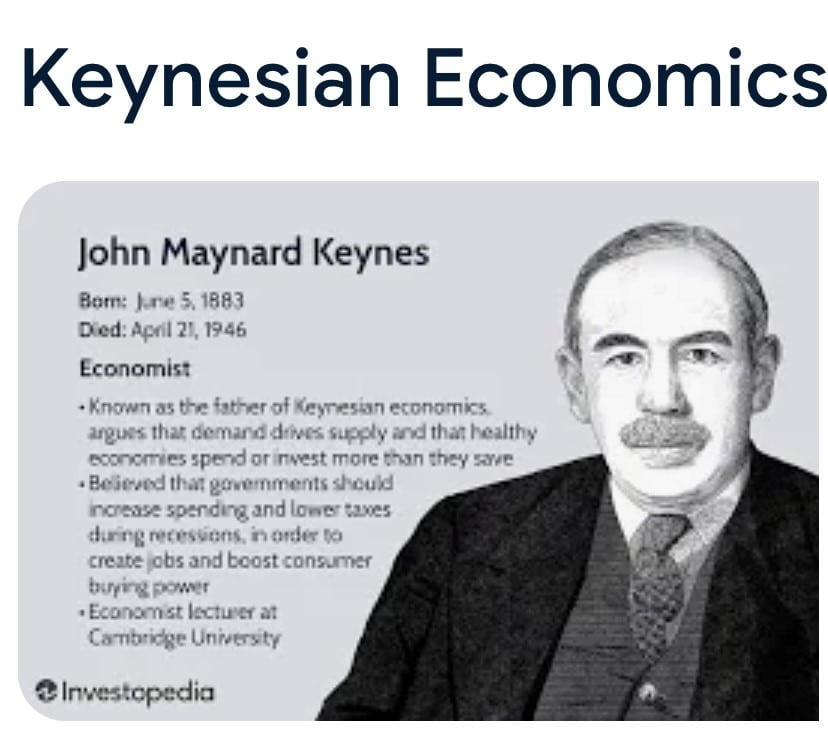
Contrary to Milton Friedman’s views, John Maynard Keynes, a distinguished British economist, staunchly supported protectionist policies. He developed a macroeconomic theory that underscores the importance of government intervention to stabilize the economy by managing aggregate demand. Keynes argued that the primary driver of economic outcomes was total spending within the economy, rather than supply-side factors. He posited that Keynesian economics recognizes the volatility of aggregate demand, which can lead to inefficient economic outcomes, including recessions and inflation. Keynes suggested that a completely free market could result in unbalanced trade and lacks inherent self-balancing mechanisms. He also believed that a mixed economy, featuring substantial government intervention, could potentially offer a more efficient solution, both for England and on a global scale.
Let’s shift our focus back to the United States at the dawn of the 20th century, extending through the period following both World Wars. During this era, the prevailing opinions in the United States heavily emphasized the principles of a free market, trade liberalization, and economic openness. Influential economists like Milton Friedman, along with others including Douglas Irwin, were vocal critics of protectionist policies. They advocated strongly for unrestricted trade, arguing that such an approach was essential for economic growth and prosperity.

The Last Supper
At a lavish dinner in an opulent dining hall, President Carter and the Shah of Iran shared a moment of camaraderie, toasting to an uncertain future. Their smiles, lit by candlelight, belied the dramatic upheavals that would unfold over the next 45 years. The Iranian Revolution would set off a chain of events that plunged the Middle East into enduring conflict, affecting regions as far as Asia. The turmoil intensified in places like Syria, Gaza, Lebanon, and Israel, largely fueled by the Islamic regime’s aggressive policies. Inside Iran, the situation worsened daily with severe repression of dissidents and exploitation of women. The regime’s push to spread its revolutionary ideals led to global condemnation and isolated incidents that embarrassed supportive Western factions.
Forty-five years on from the Iranian Revolution, the Middle East continues to be a region of intense and unrelenting conflict. The revolutionary fervor that began in Iran has not only persisted but expanded, affecting neighboring countries and reaching as far as other parts of Asia. In Syria, the situation remains dire with ongoing conflicts. Similarly, the Gaza Strip, Lebanon, and Israel are experiencing severe crises, largely influenced by the policies and actions of the Islamic regime in Iran and its proponents.
Inside Iran, the situation is worsening every day. The government’s harsh crackdown on dissent is brutal and often lethal. Iranian women are particularly vulnerable, facing horrific conditions including being subjected to sex trafficking and slavery. The regime’s aggressive push to export its revolutionary ideology has also led to international tensions, creating numerous enemies across the globe. This has included the assassination of Iranian dissidents and foreign nationals, actions that have caused significant embarrassment to Western nations, especially those with far-left political sympathies.
The Iranian regime’s ambition to establish a global Islamic caliphate has provoked widespread international and domestic opposition. This backlash is intense, with atrocities that are considered to surpass those committed during the Bolshevik Revolution in Russia, the Khmer Rouge in Cambodia, and even those of Hitler’s regime. This growing condemnation is setting the stage for a potential widespread rejection of political Islam, suggesting that change could be forthcoming.
The Carter administration’s involvement in the Middle East not only aimed to foster political freedom and stability but also inadvertently laid the groundwork for the rise of extreme religious autocracies, notably in Iran. This period also facilitated the emergence of radical Islamist movements, such as the Taliban and ISIS in Afghanistan, and influenced extremist activities in several Arab nations, including Egypt. The establishment of extremist Islamic groups like Hezbollah, Hamas, and the Houthis in Yemen contributed to increased turmoil, violence, and the regression of many developing nations.
This era of U.S. foreign policy, initiated in the 1970s and consistently followed by subsequent administrations from both major political parties, appears to have had far-reaching consequences. These policies may be linked to the bold maneuvers of North Korea, China, and Russia on the global stage, including the conflict in Ukraine. They also seem to correlate with mass migrations to Europe, increased religious radicalization within European countries, and a general state of political and financial turmoil across the continent.
Furthermore, the Middle East remains embroiled in conflict, and acts of terrorism threaten democratic institutions, including mass demonstrations in universities, destruction of properties, and the targeting of journalists. These developments raise critical questions about the wisdom of adhering to the status quo and whether the world has truly benefited from the political strategies endorsed and being followed by Western democracies since the 1970s ?
As the self-proclaimed leader of the free world, the United States holds a profound moral obligation to champion and foster sustainable progress across political, educational, cultural, and developmental spheres. This leadership should be exemplified through direct action, strategic guidance, and financial support. Recognizing that no system is flawless, the U.S. is not immune to errors in judgment, political missteps, and occasional mismanagement. Nevertheless, America’s rich national heritage and accumulated experience equip it with the necessary tools to amend mistakes, rectify errors, and restore both trust and procedural integrity.
The bi-partisan political structure in the U.S. is designed to ensure checks and balances, scrutinizing policies and decisions to prevent deviations from established norms and mitigate potential conflicts. Reflecting on the turn of the century, the U.S. embraced free-market trade policies, driven by a more liberal agenda to assume greater economic risks and burdens. This was intended to aid less fortunate and developing nations by favoring them in trade agreements and market access. Despite the noble intentions, such policies have led to significant economic disadvantages for the U.S., including a staggering national debt and a skyrocketing deficit, positioning foreign nations to exert increased economic influence over American assets.
Historically, the U.S. has also pursued policies aimed at promoting human rights and political openness, as seen in the 1970s. However, the removal of certain pro-American leaders, such as the Shah of Iran and leaders in the Philippines and Nicaragua, did not always yield the intended outcomes. Decades later, many regions around the world have seen little to no advancement in freedom; instead, they experience increased political oppression and authoritarianism. After more than a century of market liberalization and 45 years of foreign policy that largely failed to achieve its liberal objectives, it is crucial for the U.S. to revisit, re-evaluate, and potentially redirect its strategies based on scientific evidence and support for those advocating for change.
It appears that both major political parties in the United States, the Democrats and the Republicans, have strayed from their historical and moral responsibilities towards the nation and its electorate. Rather than fostering a spirit of unity and collaboration, which is crucial for effective governance, these parties increasingly prioritize personal and financial interests. This shift has led to a focus on developing for-profit enterprises at the expense of establishing educational and cultural institutions that could benefit the public.
Many Americans are expressing concerns about the lack of coherent strategies and effective political discourse. The advisory structures that should guide policy making seem inadequate, contributing to a growing dissatisfaction with the political landscape. In this environment, it is imperative for both parties to reevaluate their approaches and realign their actions with their foundational philosophies. The goal should be to fulfill their duties to the American people, rather than succumbing to the allure of populism, unchecked liberalism, or empty rhetoric.
Now is the time for Democrats and Republicans to come together, combining their diverse philosophies and strengths, to address the pressing issues facing the nation. By doing so, they can restore their commitment to the public good and rebuild trust among voters. This collaborative effort is essential for developing sustainable solutions that transcend partisan divides and truly serve the long-term interests of the United States. The focus should be on creating a political environment that values integrity, accountability, and a genuine commitment to the welfare of all Americans.
